The Honest Cost of Mobile Data in Japan, China, and Singapore
Real price data for SIMs, pocket WiFi, and eSIMs in Japan, China, and Singapore. Plus the friction points most travel guides quietly skip.
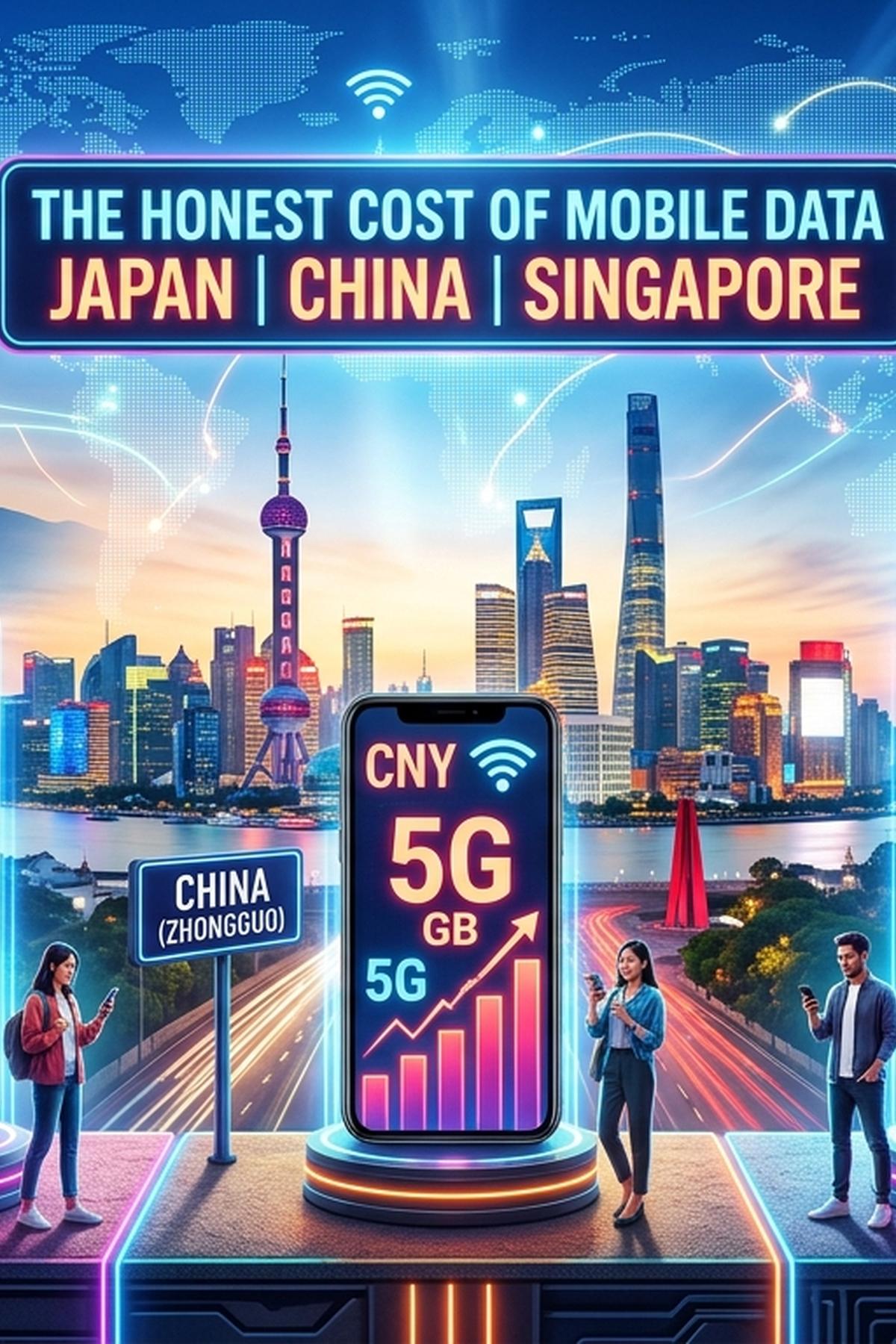
Most travelers heading to East Asia land on one of two connectivity decisions before they even pack: rent a pocket WiFi at the airport, or grab a local SIM at arrivals. Both feel like safe choices. Both are frequently the most expensive ones. The actual math only appears when you compare what each option costs per gigabyte, per day, and per logistical headache. That is what this breakdown does, country by country, with real numbers.
Airport kiosks are not the baseline. They are the premium tier.
- Airport SIM pricing in all three countries runs 20 to 40 percent above alternatives purchased in advance.
- China adds carrier registration requirements that Japan and Singapore do not, which can turn a five-minute SIM purchase into a forty-minute queue.
- Buying an eSIM before departure removes the arrivals scramble entirely and typically undercuts airport pricing by a meaningful margin.
Why Airport Connectivity Costs What It Costs
Airport retail is a captive market by design. You are tired, you need data, and there are four competing kiosks directly ahead of you. Carriers and rental companies set prices knowing that travelers at Narita, Pudong, or Changi will pay a premium rather than spend the first hours of a trip offline. The markup is not accidental.
Pocket WiFi rentals carry costs that compound in ways easy to miss at first glance. The daily rate looks manageable, but the return logistics add real friction. Most rental companies require you to post the device back before your flight or drop it at a specific counter. Lose it or damage it and the deposit disappears. For a ten-day trip, a rental often runs more than a local SIM you simply discard at the end.
There is also the single-device problem. One pocket WiFi unit means one point of failure. Everyone in your group tethers to one battery that drains through constant use. If that battery dies mid-afternoon, the whole group loses connectivity at once.
Japan: Competitive Pricing, Strict ID Rules at the Counter
Japan has some of the most reliable mobile infrastructure in Asia. Getting connected is genuinely straightforward, with one catch: purchasing a SIM at an airport counter requires showing your passport without exception. The check itself is fast. The surprise is the requirement, which catches travelers off guard when they are already running on no sleep.
What Local SIMs Actually Cost in Japan
Data-only tourist SIMs from IIJmio, NTT Docomo, and several MVNOs run between 1,500 and 3,000 JPY for a 15-day card carrying 10 to 15 GB of data. At current exchange rates, that is roughly 10 to 20 USD. Voice-capable SIMs cost more and are largely unnecessary for short visits if you use WhatsApp or Line for calls.
Airport counters at Narita Terminal 1 and 2, Haneda International, and Kansai International all stock these cards reliably. The problem is not availability. It is price. Airport retail consistently runs 10 to 15 percent above the same SIMs sold at electronics retailers in central Tokyo like Yodobashi Camera or Bic Camera. If you need data immediately upon landing, the airport SIM is a reasonable call. If you can use airport WiFi to get your bearings and pick up a card in Shinjuku or Akihabara, you save a noticeable amount on a longer trip.
When Pocket WiFi Makes Financial Sense in Japan
Pocket WiFi rental is a genuinely competitive option if you are traveling with three or more people who all need data simultaneously. The per-person math changes at that point. Typical rentals run 500 to 800 JPY per day from companies like Wi-Ho and Global WiFi. Split three ways, that falls under 300 JPY per person per day, which is cheaper than each person buying an individual SIM card. The downside remains the return logistics on departure day.
China: The Country That Rewrites the Rules Entirely
China is a different conversation from the other two markets. The connectivity challenges here extend well beyond price. They involve registration requirements, mandated bureaucracy, and a national internet policy that directly affects which apps function after you have a working connection.
Carrier Registration and the Real Wait Time
China's real-name SIM policy means every card must be tied to a verified identity document. For foreign visitors, that means your passport. The process at airports like Pudong (PVG) and Beijing Capital (PEK) varies by carrier counter. China Unicom tends to be the most tourist-friendly of the three major carriers. China Mobile and China Telecom counters sometimes present forms available only in Mandarin, which significantly slows things down for travelers who do not read Chinese.
On pricing, a tourist SIM from China Unicom at the airport runs approximately 50 to 100 CNY (roughly 7 to 14 USD) for 20 to 30 GB over 30 days. That is genuinely competitive. The friction is not the cost. It is the process. Travelers who have stood in a 40-minute registration queue at Pudong after a long-haul flight understand exactly what that trade-off means in practice.
The Filtering Variable No Connectivity Guide Mentions Clearly Enough
A Chinese SIM card gives you fast, reliable mobile data. What it does not give you is unrestricted access to the internet you rely on at home. Google, Gmail, Instagram, Facebook, WhatsApp, YouTube, and a lengthy list of other platforms are blocked under China's national internet filtering infrastructure. A VPN can help restore access, but VPN reliability inside China fluctuates and tends to degrade around politically sensitive periods.
This means a fully operational Chinese SIM may still leave you cut off from services you depend on daily. International eSIMs routed through carriers outside mainland China sometimes offer a partial workaround, though results vary by provider and by current network conditions in the region you are visiting.
Singapore: Easiest of the Three, but the Numbers Still Vary
Singapore is the most frictionless market of the three. The infrastructure is excellent, there is no content filtering, English is an official language, and Changi Airport's SIM counters rank among the most efficient in the region. If you land in Singapore and simply need to grab a SIM and go, you can do it in under ten minutes.
Tourist SIMs from Singtel, StarHub, and M1 run between SGD 15 and SGD 30 (approximately 11 to 22 USD) for plans ranging from 20 GB to unlimited data over 7 to 30 days. Pocket WiFi rentals exist but see less uptake here because local SIM pricing is already reasonable. Most short-stay visitors do better with a SIM than a rental.
The one scenario where Singapore planning matters more than travelers expect is when using it as a transit hub for broader Southeast Asia travel. A Singapore-only SIM becomes less useful the moment you cross into Malaysia or Thailand. A regional plan or a multi-country eSIM may serve that itinerary better.
Connectivity Costs Compared Across All Three Countries for a 7-Day Visit
| Country | Airport SIM | Pocket WiFi (7 days) | Pre-departure eSIM | Main Friction Point |
|---|---|---|---|---|
| Japan | USD 15, 22 | USD 25, 45 | USD 8, 15 | Passport check required in person at airport counter |
| China | USD 7, 14 | USD 35, 60 | USD 12, 20 | Real-name registration queue; firewall blocks major apps |
| Singapore | USD 11, 18 | USD 30, 50 | USD 8, 14 | Minimal; easiest setup of the three countries |
Prices are approximate and fluctuate with exchange rates and carrier promotions. The relative positioning between markets is consistent even when exact figures shift.
Why Buying an eSIM Before You Board Changes the Entire Calculation
The arrivals scramble is a real phenomenon. You have just cleared immigration, your checked bag is somewhere on the carousel, and you need to identify the right counter among five competing kiosks, each staffed by someone holding up laminated price sheets. It is avoidable. Completely.
An eSIM installed before departure bypasses the counter entirely. Your phone activates on the local network the moment the plane lands, or when you manually switch profiles if you prefer to save data during the flight. There is no physical card to lose in a carry-on pocket and no nano-SIM swap to fumble when you are already tired.
Pricing is the second variable. A country esim plan purchased before departure reliably undercuts airport SIM pricing. The difference is not dramatic on any single trip, but across three countries it compounds. Japan's airport SIM premium over pre-purchased eSIM options runs roughly 20 to 30 percent. Singapore's gap is smaller. China is the exception, where eSIM performance depends heavily on which carrier the provider routes data through and how that carrier handles domestic filtering.
Before committing to an eSIM for this region, confirm the following:
- Your phone is eSIM-compatible and carrier-unlocked. Not all budget Android devices or older iPhone models support eSIM profiles.
- The plan specifies which network it connects to in each country, since network quality varies significantly between carriers in Japan and China.
- For China specifically, ask the provider directly whether their routing handles firewall restrictions differently from a standard domestic SIM.
Where Pocket WiFi Still Has a Legitimate Argument
Pocket WiFi had a stronger case five years ago, before eSIM became widely available and before tourist SIM pricing got as competitive as it now is. The argument for renting a portable hotspot has narrowed to a few specific situations:
- Traveling as a group of four or more people who want to share a single data pool without coordinating separate SIM purchases for each person.
- Using a device that is carrier-locked or does not support eSIM, which still applies to a meaningful portion of older handsets.
- Needing to connect multiple devices simultaneously, including tablets or laptops, where tethering from a single phone becomes impractical.
Outside those scenarios, pocket WiFi typically costs more per person, requires return logistics on departure day, and introduces battery dependency at exactly the wrong moments. The eSIM interoperability framework published by the industry body that standardizes the technology is worth reading if you want to understand how carrier profiles actually load before you commit to a plan.
The Number on the Price Tag Is Not the Whole Story
Cheap data in China still runs through content filtering. Competitive SIM pricing in Japan still requires an in-person ID check at the counter. Singapore's reasonable prices come with almost no friction attached. The right choice in each country is not purely the lowest figure on a comparison sheet. It is about what that price includes and what it quietly omits.
For independent travelers doing Japan, China, and Singapore in a single trip, a combined approach usually works best. Lock in a per-country eSIM for Japan and Singapore before departure. For China, purchase a local SIM at the airport from China Unicom and budget extra time for the registration process. That approach front-loads all the connectivity decisions, removes the arrivals-day pressure, and leaves your energy for the actual trip instead of the logistics around it.
Read next
-
 Fifth Freedom Flights Are the Award Sweet Spot Nobody Searches For
Fifth-freedom flights let you fly a foreign airline between two other countries, and they often have award seats when the airline's own hub routes are sold out.
Fifth Freedom Flights Are the Award Sweet Spot Nobody Searches For
Fifth-freedom flights let you fly a foreign airline between two other countries, and they often have award seats when the airline's own hub routes are sold out.
-
 Every Way Into an Airport Lounge and What Each One Actually Costs You
-
 When a Mileage Upgrade Is the Wrong Way to Spend Miles
Upgrading a paid ticket with miles sounds efficient but the required fare class often costs so much that a straight award booking in the same cabin is cheaper.
When a Mileage Upgrade Is the Wrong Way to Spend Miles
Upgrading a paid ticket with miles sounds efficient but the required fare class often costs so much that a straight award booking in the same cabin is cheaper.
-
 Mistake Fares and Whether an Airline Actually Has to Honour Your Ticket
Mistake fares generate excitement but most airlines cancel them and refund your money, and the US DOT rarely forces them to honour the ticket.
Mistake Fares and Whether an Airline Actually Has to Honour Your Ticket
Mistake fares generate excitement but most airlines cancel them and refund your money, and the US DOT rarely forces them to honour the ticket.