Jordan, Kowloon: Where Old Hong Kong Still Starts After Sunset
Jordan is Kowloon at its most unvarnished, with Temple Street's fortune tellers after dark and the Jade Market haggling by day.
- Flag
-
- ISO code
- HK
Jordan, Kowloon: Where Old Hong Kong Still Starts After Sunset
Temple Street at 21:00 is the reason you chose Jordan. Not the hotels, not the MTR frequency, not the proximity to Tsim Sha Tsui. You came for the tent of a fortune teller operating under a yellow flicker, for the plastic tubs of live crab on the pavement, for the older man at a dai pai dong who is three plates of clams into his evening and still ordering beer from the woman who never writes anything down. Jordan is the messy, functional middle floor of Kowloon, the one tourists walk through on the way to somewhere else. Base yourself here and you stop walking through.
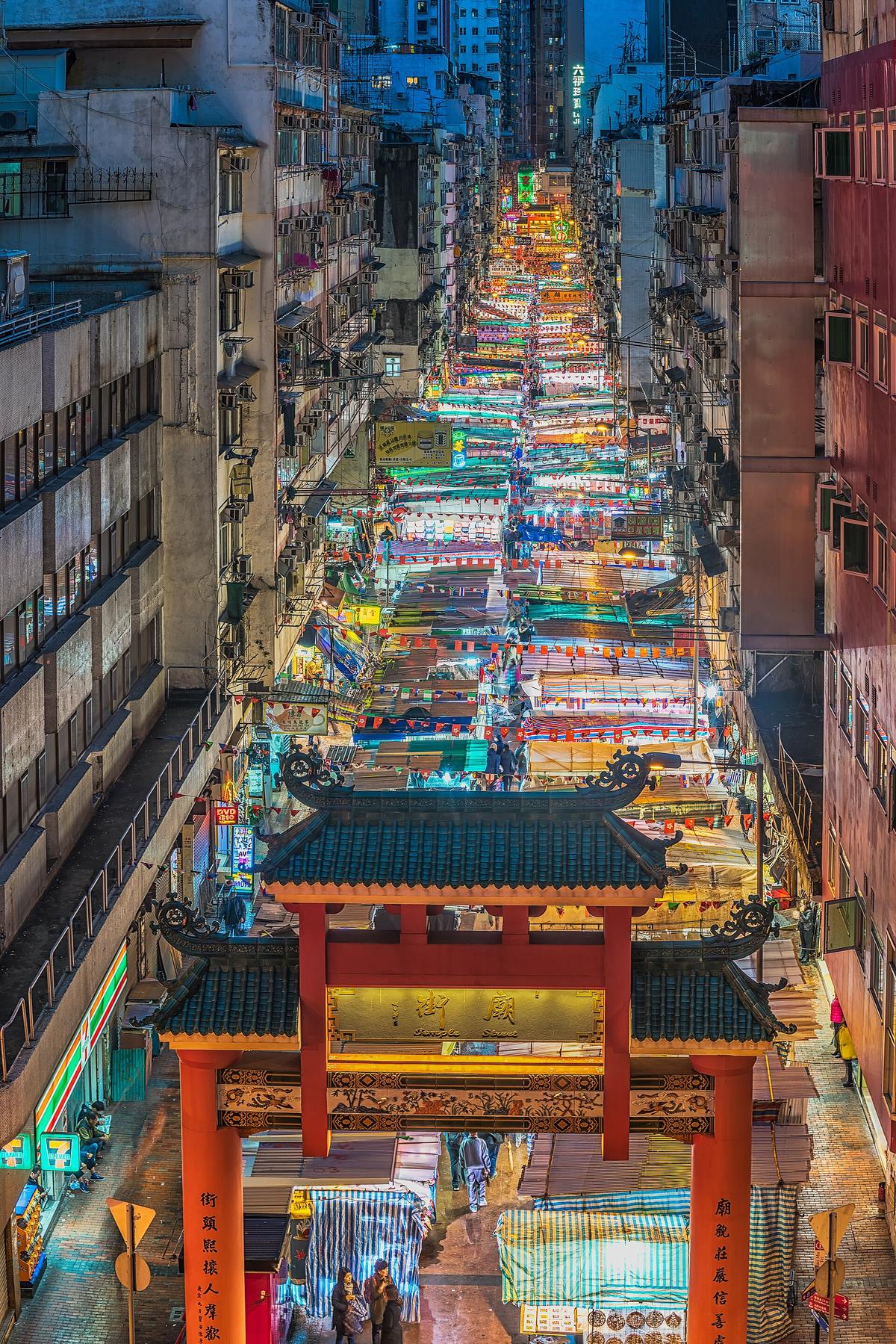
The district occupies a tight rectangle a little less than five square blocks. Its northern edge runs along Austin Road and Jordan Road; its southern boundary follows Nanking Street and Kimberley Road. Cox's Road and Gascoigne Road mark the east. Ferry Street and Canton Road seal the west. The geography matters because Jordan has no blockbuster sight. The reason to stay is the texture of a lane that shifts purpose hour by hour. Temple Street, roughly 600 metres from Jordan Road down to Kansu Street, operates as a through road during daylight: garages open their roller shutters, shops sell hardware, and a few dai pai dong serve lunch. By 16:00 the market stalls begin assembling, around 100 to 150 of them, according to the Travel Industry Authority's annual count. By 19:00 the street is closed to cars and given over to clothing, watches, electronics, sex toys, and the smell of wok hei. Peak hours run 19:00 to 22:00. Go at 17:30 and you can watch the transformation happen.
You do not come to Jordan for luxury. There are zero luxury hotels here. The accommodation stock runs from budget guesthouses at around HK$200 to 300 per night, mid-range hotels at HK$700 to 1,200, and a handful of hostels. Most of the cheapest beds cluster toward the Tsim Sha Tsui edge, inside the warrens of Chungking Mansions and Mirador Mansions. The trade-off is direct. You get a small room, often windowless. You get a neighbourhood that does not feel curated. Jordan is not pretty. But it is alive in a way that the renovated waterfront of Tsim Sha Tsui, one stop south on the MTR, stopped being alive a decade ago.
.jpg)
The Night Market and the Trade That Operating Hours Forgot
Temple Street After Dark
Temple Street runs roughly 600 metres from Jordan Road south to Kansu Street. Do not make the common mistake of treating it as one market. The southern half, near the Tin Hau Temple, is dominated by food: dai pai dong serving claypot rice, stir-fried clams, and satay skewers. The northern half is dry goods. The jewellery stalls are concentrated around the temple itself. A separate lane, parallel on the west side, holds the fortune tellers, about 20 to 30 stalls operating on the temple's perimeter. Most offer face reading, palm reading, or bazi (Chinese horoscope) in Cantonese. Some speak Mandarin. Few speak English. If you do not speak any Chinese, you can still sit down and let the reader work. The main show is the pattern of gestures and the customer's reaction.
The Tin Hau Temple at 56-58 Temple Street was built between 1864 and 1865, making it older than the market that now surrounds it. The market itself began in the 1970s, when street hawkers started gathering outside the temple and the nearby Yau Ma Tei Typhoon Shelter. Entry to the temple is free and it is open roughly 08:00 to 17:00 daily. It operates under the Chinese Temples Committee. Inside, the smell of incense coils is thick enough to register on your clothes. The temple square occasionally hosts Cantonese opera performances. Those are not scheduled weekly. If you want to catch one, check the committee's noticeboard near the main entrance or ask at the temple office the day before. You will need to be lucky.
The Jade Market Under the Flyover
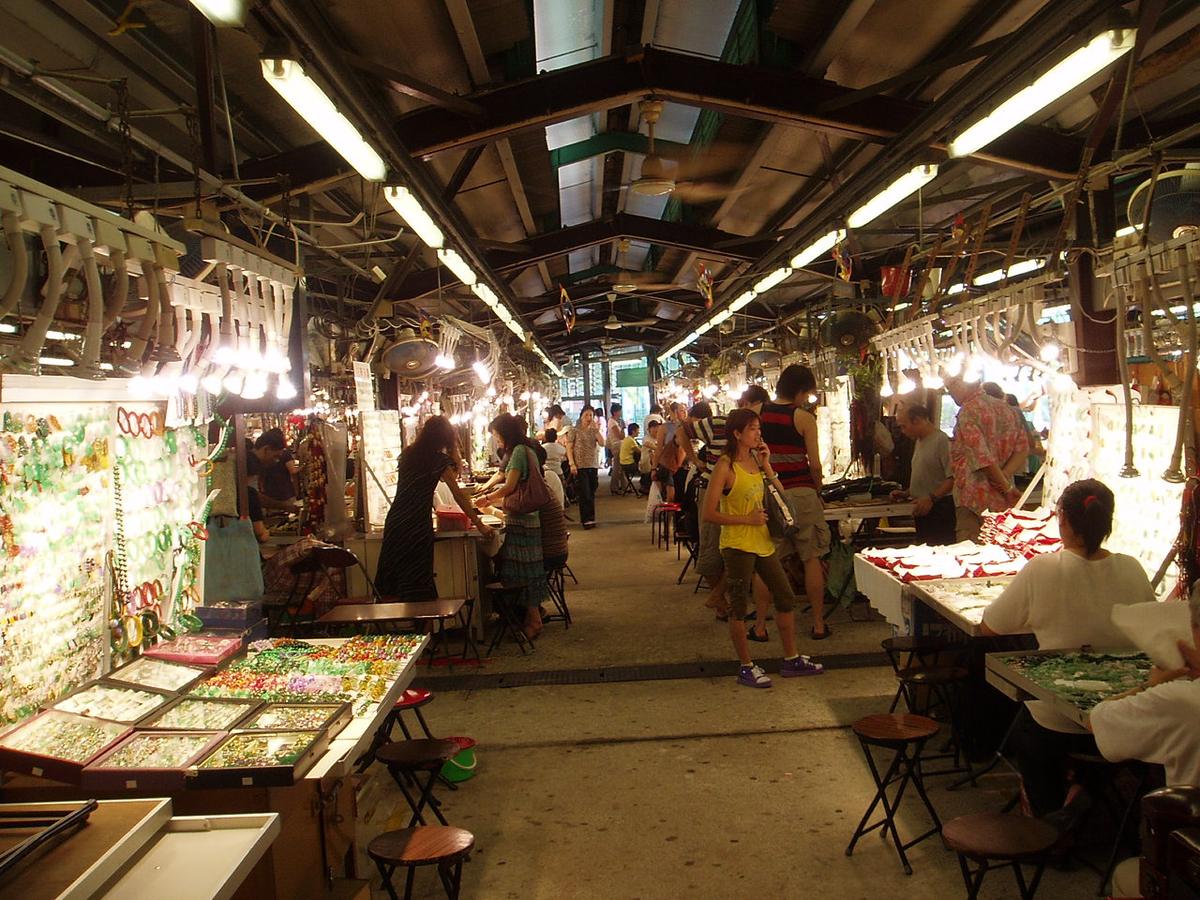
Five minutes on foot east from Temple Street, under the Kansu Street flyover at 251 Shanghai Street, the Jade Market holds about 400 stalls. It relocated here from its original site on Canton Road in 1984. Hours are roughly 10:00 to 17:00 daily, though some stalls close for major Chinese holidays. Go early, before 11:00, when the dealers are still setting up and the light under the flyover is at its best for seeing colour. The jade sold here covers the full spectrum: genuine jadeite and nephrite, dyed quartz, serpentine, and glass. There is no universal grading system. The price range runs from HK$50 for a small pendant to HK$5,000 or more for a bangle with good translucency. Bargaining is expected. Some stalls will offer a certificate for higher-priced items. Treat it as a piece of paper, not a guarantee. If you care about authenticity, buy from a stall that lets you inspect the stone in natural light and ask the dealer to explain the colour distribution. A dealer who dodges that question is selling treated material.
The market is surrounded by its daytime counterparts. Along Shanghai Street between Jordan Road and Waterloo Road, the kitchenware shops cluster. Between Jordan Road and Austin Road, the bridal shops appear. These are the functional edges of the jade trade: the people who sell the ceremonial garments and the banquet equipment. Walk this stretch at 15:00 and you will see workers eating lunch on upturned crates, a sight that belongs to the Kowloon that redevelopment has not yet erased.
Daytime Jordan: Wet Markets, Fruit, and the Structures That Hold a Neighbourhood Together
Jordan works best as a base when you understand its daytime rhythm, because the neighbourhood does not sleep through the afternoon. The Reclamation Street wet market runs roughly from Jordan Road up to Mong Kok Road, selling fresh meat, fish, poultry, and vegetables. It is a working market, not a tourist attraction. Go at 07:00. The concrete floors are wet from hosing. Stall holders call out prices. There is no English. Buy a bag of lychees and a piece of ginger and you become part of the transaction instead of just watching it.
The Yau Ma Tei Fruit Market at 2 Waterloo Road, a Grade 2 historic building constructed in 1913, operates as a wholesale market. Peak activity is 04:00 to 06:00, when forklifts move pallets and shouting fills the air. The site is open to the public with no ticket, but 03:00 is not a tourist hour. Go at 07:00 instead, when the wholesale rush has quietened and the dealers are packing up. The pre-war brick and stone architecture is visible then without the chaos. Some 200 to 250 stalls trade fruit here year-round, with the highest volumes before Chinese New Year. If the site looks familiar, it has appeared in several Hong Kong films as the backdrop for early-morning drug deals and police raids.
Woosung Street After Dark
Woosung Street, a 350-metre lane running from Jordan Road to Austin Road, does its best work after 20:00. The street has the highest concentration of Sichuan and Chongqing hotpot restaurants in the district. Tables spill onto the pavement. The broth arrives in a divided pot, one side mild and one side blistering with dried chilli. This is not a date-night street. It is loud, steamy, and greasy. Bring cash. Many of the smaller places do not take cards. Budget around HK$200 to 300 per person for a full meal with beer.

Staying Put Versus Moving South: What Jordan Does Better Than Tsim Sha Tsui and Mong Kok
Jordan MTR station opened on 16 December 1979 and sits on the Tsuen Wan line. From Jordan to Tsim Sha Tsui is one stop south. To Mong Kok is one stop north. To Central is about eight minutes. The district is the best-connected budget base in Kowloon. Cross-harbour bus routes including the 970 and 970X run from Jordan to Hong Kong Island. The overnight bus N21 connects to the airport. The free K1 shuttle runs from Jordan MTR to Kowloon Station for the Airport Express, getting you to the airport in about 25 to 30 minutes total, including the transfer. Hong Kong West Kowloon Station, for the high-speed rail to Shenzhen (18 minutes) or Guangzhou (50 minutes), is a 10 to 15 minute walk east.
What Jordan is bad at: green space. There is no park of note. Kowloon Park is a 10-minute walk south. The Avenue of Stars is 20 minutes south. The area is dense concrete, narrow pavements, and scaffolding. It is not a gentle part of Hong Kong. The city as a whole is exhausting for all the reasons listed in the travel brief: crowds, humidity, relentless verticality. Jordan concentrates those qualities without offering the relief of a harbour view or a hotel rooftop bar.
Hong Kong is dense, vertical, and efficient, but it is not a gentle introduction to Asia. Visitors find it more exhausting than expected, while also being surprised by how much wild green space and village life exists 30 minutes from Central. Jordan is for the visitor who wants to eat at dai pai dongs and hole-in-the-wall noodle shops, who values public transport efficiency, and who does not need a sea view from the bedroom window. It is not for travellers on a tight budget who want cheap street food and hostels. It is not for anyone seeking a relaxed, slow-paced environment. Jordan works best for the urban explorer who understands that the Kowloon of the 1970s is still visible here, under the fluorescent lights of Temple Street at 21:00, and that it will not stay visible forever.
Common Questions
How long does it take to walk from Jordan MTR to Temple Street night market?
About five minutes. Exit A of Jordan MTR station puts you directly onto Jordan Road at the northern end of Temple Street. The walk is flat and takes you straight into the market's densest section.
Is the Jade Market open every day?
The market operates roughly 10:00 to 17:00 daily, but some stalls close on major Chinese holidays. Arrive before 11:00 for the best light under the flyover. The market is most reliable from Tuesday through Sunday.
Can I use a credit card at Temple Street food stalls?
No. Temple Street dai pai dong and most smaller Jordan restaurants are cash only or accept Octopus. Several ATMs cluster around Jordan MTR Exit A. Take out cash before you arrive. You will need it.
What time does the last MTR leave Jordan for Central?
The last train from Jordan to Central on the Tsuen Wan line departs around 00:50 weekdays and Sundays. After that, the N21 overnight bus runs from Jordan Road to Hong Kong Island and the airport.
Read next
-
 Hong Kong eSIM and Data Plans Before You Land
Hong Kong has no internet firewall. A cheap eSIM or tourist SIM from the airport gives you fast data for Google Maps and WhatsApp from the moment you land.
Hong Kong eSIM and Data Plans Before You Land
Hong Kong has no internet firewall. A cheap eSIM or tourist SIM from the airport gives you fast data for Google Maps and WhatsApp from the moment you land.
-
 Hong Kong Hotels by Price Band and Property Type
Hong Kong hotel rooms are small, but the difference between a luxury harbour-view tower and a Mong Kok budget room is enormous.
Hong Kong Hotels by Price Band and Property Type
Hong Kong hotel rooms are small, but the difference between a luxury harbour-view tower and a Mong Kok budget room is enormous.
-
 Where to Stay in Hong Kong Island or Kowloon for a First Visit
Hong Kong Island puts you in the financial and dining core, while Kowloon gives you harbour views and street life. The street you pick matters more than the district.
Where to Stay in Hong Kong Island or Kowloon for a First Visit
Hong Kong Island puts you in the financial and dining core, while Kowloon gives you harbour views and street life. The street you pick matters more than the district.
-
 How to Find Cheap Flights to Hong Kong International Airport
Hong Kong has one airport, a lot of airline competition, and a fast train into the city. The routing tricks are in the booking, not the arrival.
How to Find Cheap Flights to Hong Kong International Airport
Hong Kong has one airport, a lot of airline competition, and a fast train into the city. The routing tricks are in the booking, not the arrival.
-
 Things to Do in Hong Kong Ranked by What Is Worth Your Time
Victoria Peak, the Star Ferry, and a serious hike earn their fame. Some other Hong Kong sights do not.
Things to Do in Hong Kong Ranked by What Is Worth Your Time
Victoria Peak, the Star Ferry, and a serious hike earn their fame. Some other Hong Kong sights do not.
-
 Best Time to Visit Hong Kong for Clear Skies and Low Humidity
October to December offers the best balance of clear skies and low humidity, but every other season trades weather for lower prices or festivals.
Best Time to Visit Hong Kong for Clear Skies and Low Humidity
October to December offers the best balance of clear skies and low humidity, but every other season trades weather for lower prices or festivals.
-
 Sham Shui Po
 is Hong Kong's poorest district and its most compelling argument for eating your way through a neighbourhood.
Sham Shui Po
Sham Shui Po is Hong Kong's poorest district and its most compelling argument for eating your way through a neighbourhood.
-
 Tsim Sha Tsui
 gives you the best free view of the Hong Kong skyline, plus museums and the Star Ferry. Here's how to plan a day.
Tsim Sha Tsui
Tsim Sha Tsui gives you the best free view of the Hong Kong skyline, plus museums and the Star Ferry. Here's how to plan a day.
-
 Mong Kok
 is the densest place on earth, organised into streets that each sell one thing. Here's how to navigate it without losing your nerve.
Mong Kok
Mong Kok is the densest place on earth, organised into streets that each sell one thing. Here's how to navigate it without losing your nerve.