What Japan, China, and Singapore Actually Cost Independent Travelers
Real per-day costs for Japan, China, and Singapore broken down by accommodation tier, food strategy, transit, and connectivity for independent travelers.
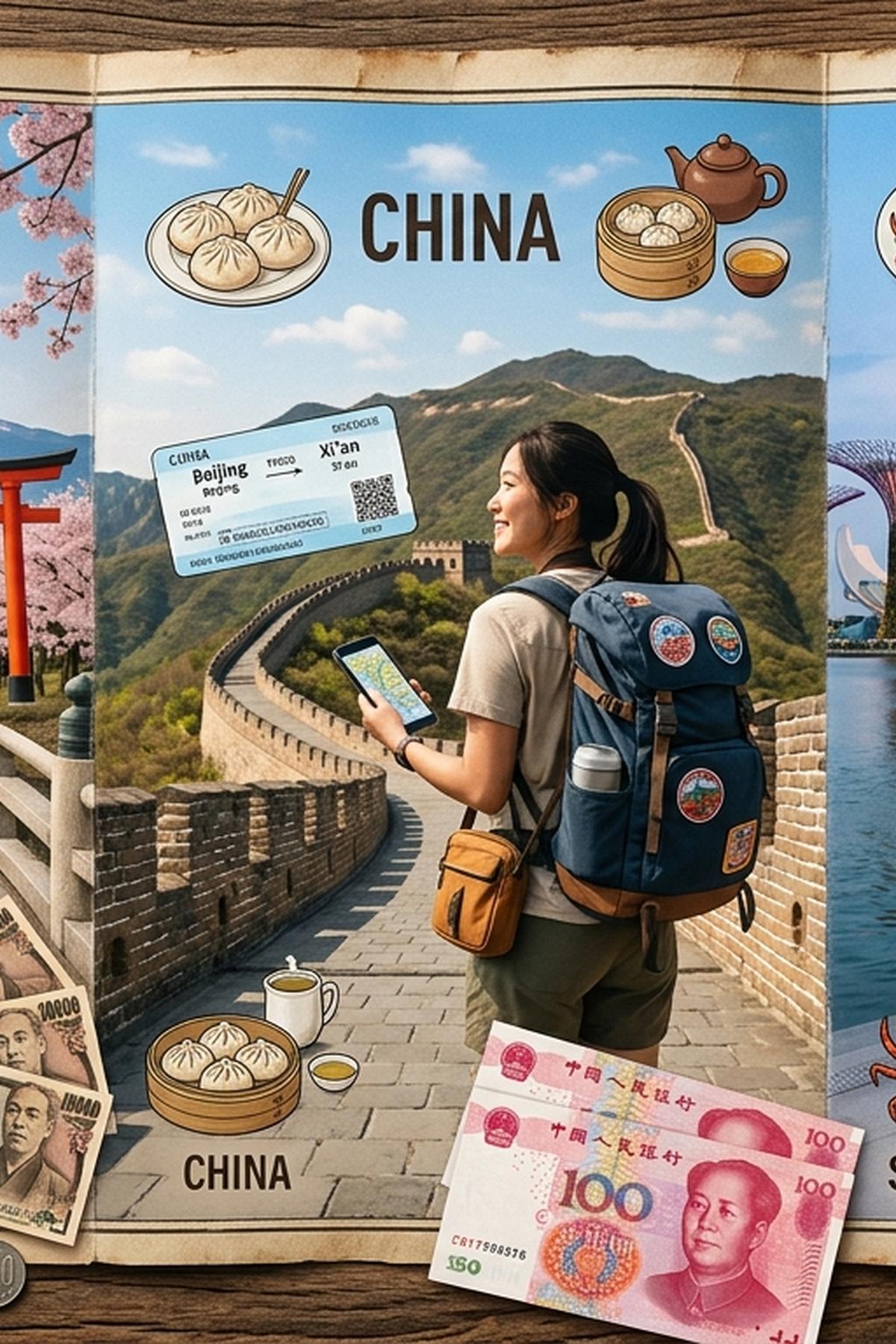
The number you've seen quoted about Japan being expensive is probably accurate. The number you've seen about China being cheap is probably accurate too. The problem is that country-level averages are nearly useless for planning a real trip. They flatten the difference between a hostel dorm in Osaka's Namba district and a business hotel in Tokyo's Shinjuku. They don't account for what you eat, how you move, or whether you're operating inside the international tourist bubble. This article works through the actual numbers, category by category, so you can build a realistic daily budget before you book anything.
The Real Numbers at a Glance
Japan runs $60 to $100 per day for budget-conscious solo travelers outside the premium hotel tier. China can drop below $40 if you sleep and eat the way locals do, but that number falls apart fast once you rely on international-facing infrastructure. Singapore rarely dips below $80 even with careful planning. All three countries reward advance research and punish assumptions hard. These figures assume solo travel with public transit, budget accommodation, and no packaged tours.
Why Country-Level Averages Fail Independent Travelers
Budget guides average across an entire country. That produces a number like "Japan costs $80 a day" without specifying that Tokyo's Yamanote loop and Osaka's Shin-Osaka station area operate on entirely different price floors. A capsule hotel in central Osaka runs $25 to $35 per night. A budget business hotel in central Tokyo runs $70 to $120 for the same period. That's not a rounding error. That's the difference between a trip that fits your budget and one that doesn't.
Timing compounds the problem. Japan's cherry blossom window drives accommodation up 40 to 60 percent in popular cities. China's Golden Week national holiday creates similar surges. Singapore's Formula 1 period warps hotel pricing across the entire island. Any guide that quotes you a flat daily figure without flagging seasonal variation is handing you data that could genuinely mislead your planning.
The other factor is the tourist infrastructure layer. In all three countries, a parallel economy exists specifically for international visitors: English-menu restaurants, internationally branded hotels, tour-company transport. That layer costs more, often significantly more, than what locals pay. The travelers who blow their budgets are almost always the ones who defaulted to that layer without realising it.
Japan's Real Costs, From Hostels in Osaka to Business Hotels in Tokyo
Accommodation in Japan spans a genuine range. Hostel dorms in most major cities run $20 to $35 per night. Budget business hotel chains like Toyoko Inn and APA Hotel run $50 to $90. Mid-range properties with more space and private bathrooms land at $100 to $180. Tokyo is consistently the most expensive city. Osaka, Kyoto, and Hiroshima are meaningfully cheaper, sometimes by 25 to 35 percent for comparable properties.
Food is Japan's clearest budget advantage, and convenience stores are central to it. A 7-Eleven or Lawson onigiri with hot coffee runs under $4. A ramen or soba lunch at a basic restaurant costs $8 to $12. A sit-down dinner with drinks at a mid-tier restaurant runs $20 to $35. The move that experienced Japan travelers use is leaning on convenience stores for breakfast, targeting restaurants at lunch rather than dinner when set menus are significantly cheaper, and using department store basement food halls for affordable evening options.
Data from Japan's national tourism organisation consistently shows that first-time visitors underestimate daily spending in Tokyo, with accommodation cited as the most commonly underbudgeted line item, particularly during peak seasons. Build buffer room into your Japan estimates. A realistic budget day, based on a hostel or cheap guesthouse, convenience store meals plus one sit-down restaurant meal, and subway transit, lands around $60 to $80.
China's Price Advantage Only Works If You Step Outside the Tourist Layer
China's low-cost reputation is real, but it requires deliberate setup to access. A local guesthouse or budget chain hotel outside the international hotel district runs $15 to $25 per night. That same neighborhood, once you cross into the international hotel zone near major tourist sites, jumps to $70 to $120. The gap is not subtle.
Food follows the same logic. A street food meal or a dish at a local restaurant without a picture menu or English translation runs $1 to $4. A proper sit-down meal at a local place costs $5 to $10 per person. The moment you walk into a restaurant with a laminated English menu and food photography on the walls, you're in tourist pricing territory: $15 to $25 per person, and often for lower quality.
Subway transit across Chinese cities is the cheapest in the region. A typical trip costs $0.30 to $0.80. Getting to grips with the metro apps takes effort, but the savings are real and the networks are genuinely excellent in cities like Shanghai, Beijing, and Chengdu.
There are two logistics hurdles you cannot ignore. The first is connectivity. Google Maps, Gmail, WhatsApp, Instagram, and most Western apps are blocked at the network level in China. A working VPN, installed and tested before you cross the border, is not optional. The second is payment. WeChat Pay and Alipay dominate. Cash is increasingly difficult to use in cities. Foreign visitors can now link international Visa or Mastercard cards to WeChat Pay, but the setup requires a functioning Chinese phone number and advance planning. Neither of these is a dealbreaker. Both become a dealbreaker if you ignore them until you land.
A realistic budget day in China, assuming local guesthouse accommodation, street food and local restaurant meals, and subway transit, lands around $30 to $45. That number rises quickly if you skip the prep work.
What Singapore Actually Costs Without the Tourist Markup
Singapore is expensive by Southeast Asian standards, but it compares reasonably to major Western cities if you eat at hawker centers and stay away from the Marina Bay tourist orbit. A hostel dorm runs $25 to $45 per night. Budget guesthouses in neighborhoods like Geylang, Little India, or Joo Chiat run $50 to $80. Mid-range hotels land at $120 to $180, and there isn't much in between those tiers.
The hawker center is your budget lifeline here. A full meal at Maxwell Food Centre, Tiong Bahru Market, or Lau Pa Sat runs $3 to $6. The food is genuinely excellent and the variety is wide. Eating at restaurants near Boat Quay, the CBD, or Marina Bay Sands costs three to four times as much for food that is often inferior. This is not a minor difference. It is the single biggest variable in your Singapore daily total.
The MRT is one of the most efficient transit systems in Asia. A single trip rarely exceeds $2.50 and you can get across the entire island for under $5. The Land Transport Authority publishes comprehensive fare schedules and route maps, making trip planning straightforward even on your first day. Add $8 to $15 for a tourist eSIM valid for 7 days, and connectivity is handled before you land.
The hidden cost in Singapore is alcohol and nightlife. A beer at a bar costs $10 to $15. Two drinks can quietly add $25 to your daily total. Factor this in honestly or factor it out entirely. A realistic budget day, combining hostel accommodation, hawker meals, and MRT transit, runs $65 to $85.
Feeding Yourself Across All Three Countries Without Getting Ripped Off
The food strategy differs by country, but the underlying principle is consistent across all three: distance yourself from tourist-facing infrastructure, and prices drop immediately. Here is what that looks like on the ground:
- Japan: Use convenience stores for breakfast and quick lunches. Target restaurants at midday for your main meal, when set menus are priced well below dinner equivalents. Department store basement food halls are an underrated option for affordable, high-quality evening meals. Avoid restaurants with tourist photo menus near major sights.
- China: Any restaurant without a picture menu or English signage is almost always cheaper and often better. University-adjacent neighborhoods in Shanghai and Beijing consistently have the most affordable sit-down food. Food courts inside Chinese shopping malls, not Western-style ones, are a reliable low-cost option across most cities.
- Singapore: Eat at hawker centers for every meal you can manage. Avoid tourist-facing districts for food entirely. Even mid-range restaurants in central Singapore add a 10 percent service charge and 9 percent GST, turning a $15 dish into $18.50 before you have done anything unusual.
Transit and Connectivity Costs Across All Three Countries
Public transit is excellent across Japan, China, and Singapore. Japan's rail network is the most complex but also the most reliable. An IC card loaded with credit handles nearly every transit situation in the country. The Japan Rail Pass is only worth purchasing if you're doing three or more bullet train journeys between cities, and the math on that is tighter than most people assume.
China's high-speed rail connects every major city at a fraction of flight costs and the trains are genuinely fast. Shanghai to Beijing takes under five hours. Booking in advance through the official rail platform is the most direct route, though it requires a Chinese account or a third-party service that charges booking fees.
For connectivity, Japan and Singapore are both straightforward. A tourist eSIM covers either country affordably. China requires a separate layer of planning. Most standard eSIMs that cover Asia do not penetrate China's network filters. You need a provider that explicitly supports mainland China data access. Combine that with a VPN subscription tested before arrival, and your connectivity is solid. Before you lock in a destination sequence, cross-referencing solid Asia travel guides will tell you which city pairs are currently affordable to connect versus where transit costs will quietly drain your budget buffer.
Per-Day Cost Estimates Across Traveler Tiers and Destinations
| Category | Japan (Tokyo) | China (Shanghai) | Singapore |
|---|---|---|---|
| Budget accommodation (per night) | $30 to $45 | $15 to $25 | $25 to $45 |
| Mid-range hotel (per night) | $90 to $150 | $45 to $85 | $120 to $180 |
| Daily food, budget strategy | $15 to $20 | $5 to $12 | $8 to $15 |
| Daily food, mid-range | $30 to $50 | $15 to $30 | $25 to $45 |
| Daily transit (public) | $5 to $10 | $2 to $4 | $3 to $6 |
| eSIM (avg. per day, 7-day plan) | $2 to $3 | $3 to $5 | $1 to $2 |
| Total, budget traveler | $60 to $80/day | $28 to $45/day | $65 to $85/day |
| Total, mid-range traveler | $130 to $220/day | $65 to $125/day | $155 to $235/day |
The Order That Actually Matches Your Money to the Experience
Start in Singapore if you want a smooth entry into East Asia. English is universal, transit signage is bilingual, and the MRT takes about 15 minutes to learn. There are no VPN configurations, no payment app setups, and no language barrier to clear before you can do basic things. It costs more per day than the other two destinations. But you will spend less money on logistical errors and less time confused by infrastructure you haven't encountered before.
Start in Tokyo if you want the highest concentration of genuinely interesting things within a compact urban area, and if you're comfortable moving through a city where most signage is in Japanese. Japan has the steepest day-one learning curve of the three destinations. It also has the most forgiving environment: low crime, excellent transit coverage, and convenience stores on every corner that solve an impressive number of problems you didn't anticipate.
Save China for last, or at least after you've done the groundwork. The cost advantage is the most dramatic of the three destinations, but it only materializes if you arrive with a working VPN, a payment solution that functions outside international hotel desks, and enough trip experience to seek out local-facing restaurants and accommodation on your own. First-time visitors who head to China without that preparation end up paying tourist prices at every tier and return convinced the cheap reputation was exaggerated. It is not exaggerated. It is contingent on doing the work beforehand.
The honest version of East Asia travel costs is this: none of these countries has a single price. Each operates two parallel economies running side by side, and your daily spend is mostly a function of which one you're operating in. The travelers who get the most out of their budget are not the ones who find the cheapest flights. They're the ones who understood the layer structure before they landed.
Read next
-
 What Most Travelers Get Wrong When Booking Flights to East Asia
Most travelers book East Asia flights on price alone. Here's what they miss about route gaps, fleet age, and aircraft type on 10-14 hour hauls.
What Most Travelers Get Wrong When Booking Flights to East Asia
Most travelers book East Asia flights on price alone. Here's what they miss about route gaps, fleet age, and aircraft type on 10-14 hour hauls.
-
 The Honest Cost of Mobile Data in Japan, China, and Singapore
Real price data for SIMs, pocket WiFi, and eSIMs in Japan, China, and Singapore. Plus the friction points most travel guides quietly skip.
The Honest Cost of Mobile Data in Japan, China, and Singapore
Real price data for SIMs, pocket WiFi, and eSIMs in Japan, China, and Singapore. Plus the friction points most travel guides quietly skip.
-
 Fifth Freedom Flights Are the Award Sweet Spot Nobody Searches For
Fifth-freedom flights let you fly a foreign airline between two other countries, and they often have award seats when the airline's own hub routes are sold out.
Fifth Freedom Flights Are the Award Sweet Spot Nobody Searches For
Fifth-freedom flights let you fly a foreign airline between two other countries, and they often have award seats when the airline's own hub routes are sold out.
-
 Every Way Into an Airport Lounge and What Each One Actually Costs You