Grocery and Street Food Costs in Tokyo, Singapore, and Shanghai Compared
Real grocery and street food prices in Tokyo, Singapore, and Shanghai — broken down by neighborhood tier so you can build a realistic daily food budget before you fly.
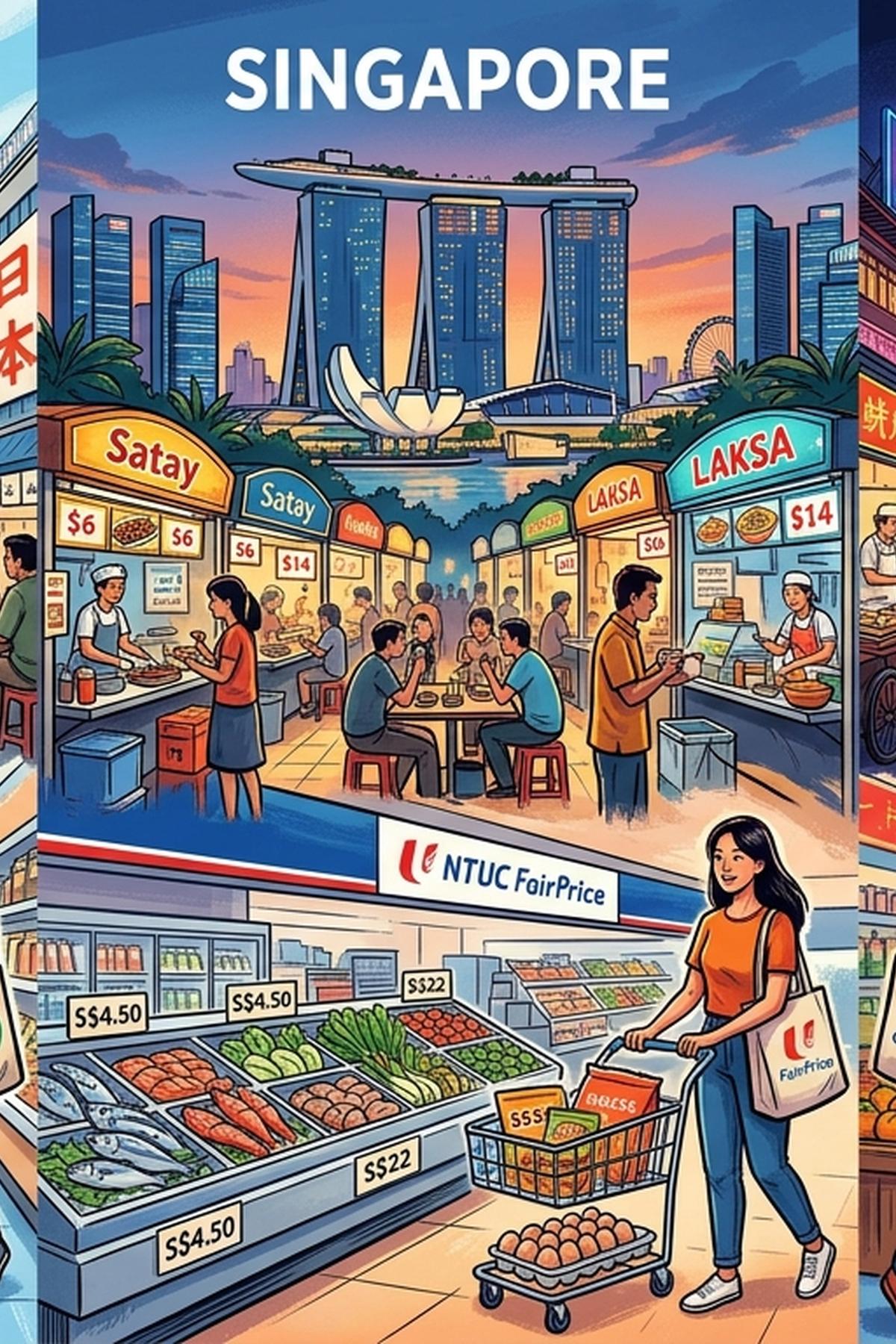
Most travelers price out food in Asian cities by reading the wrong sources. They find a photo of ¥800 ramen on Instagram and assume Tokyo is reasonable. They read one paragraph about hawker centers and assume Singapore is cheap. Then they land, walk into a supermarket for morning supplies, and the receipt rewrites their entire trip plan. This breakdown skips the highlight reel. It covers what a dozen eggs actually costs, what a wet market haul looks like in each city, and exactly where the per-neighborhood price gap will hit your wallet.
Before You Book: Food Budget Realities
- Shanghai is the clearest win for budget street food, with full meals available for CNY 6 to CNY 20 in residential zones.
- Tokyo's convenience store network is one of the strongest budget lifelines in any major city , consistent quality, with meals from ¥500.
- Singapore's hawker centers hold daily food costs to SGD 15 to SGD 22, but supermarket grocery bills are the highest of these three cities.
- Neighborhood tier affects prices by 20 to 40 percent across all three cities , tourist-corridor supermarkets cost significantly more than residential ones.
- Benchmarking these numbers against your home grocery costs before you fly is the fastest way to gauge where real sticker shock will hit.
Why Neighborhood Tier Matters More Than City Reputation
A carton of eggs in Shibuya is not the same price as a carton of eggs in Koenji. A bottle of soy sauce at a Singapore supermarket in Orchard Road costs more than the same bottle in Bedok. A bowl of noodles in Xintiandi, Shanghai, costs five times what the same bowl costs in Putuo District.
In all three cities, the tourist-zone and central business district premium on packaged grocery items runs between 20 and 40 percent above residential-zone prices. Wet markets and neighborhood food stalls exist almost exclusively outside tourist corridors. This means the accommodation decision is also a food budget decision. Staying in a well-located tourist district and saving on the room rate can cost you more in daily food than the rate difference saves.
The practical takeaway: find the nearest residential supermarket on your first day. In Tokyo, that means chains like OK Store, Maruetsu, or Gyomu Super. In Singapore, look for FairPrice in a residential estate rather than a mall. In Shanghai, Hema and Lianhua stores in non-tourist neighborhoods are your benchmark.
Tokyo: Cheaper Than Its Reputation Once You Know Where to Look
Tokyo's food reputation is built on two very different realities. The expensive version is real. Department store basement food halls, tourist-district restaurants, and seasonal gift fruit are all priced at levels that would shock anyone on a tight budget. The affordable version is also real, and it is much larger than the expensive one.
At a residential chain supermarket, a dozen eggs runs ¥198 to ¥260. A 1-liter carton of milk costs ¥180 to ¥250. A standard loaf of sliced bread lands at ¥130 to ¥200. Tofu sits at ¥50 to ¥100 per block. These are prices that compare well with most developed countries. Seasonal vegetables, especially domestic spinach, bean sprouts, and daikon, regularly come in below ¥150 per bag.
The real budget infrastructure in Tokyo is the convenience store. 7-Eleven, FamilyMart, and Lawson all sell onigiri from ¥110, hot steamed buns from ¥100, sandwiches from ¥200, and full bento boxes from ¥450 to ¥800. Quality is consistently high. A traveler who eats breakfast from a residential supermarket and relies on convenience stores for two meals a day can hold a daily food budget under ¥2,000, which sits at roughly USD 13 to 14 at current exchange rates.
Tokyo's Shotengai: The Local Equivalent of a Wet Market
Tokyo's version of the traditional market is the shotengai, a covered shopping street in older residential neighborhoods. Koenji, Togoshi Ginza, and Musashi-Koyama all have long shotengai with fishmongers, butchers, and produce sellers priced below supermarket chains. These are not in any guidebook. They are one or two train stops past wherever most tourists stay.
Singapore: Hawker Centers Save the Budget, Supermarkets Test It
Singapore is legitimately expensive for packaged groceries. It is also home to one of the best networks of affordable cooked food in the world, and that network is what makes the city budget-viable for most independent travelers.
A full meal at a hawker center, whether chicken rice at Maxwell Food Centre or char kway teow at Old Airport Road, costs SGD 4 to SGD 6 at most stalls. A drink adds SGD 1.20 to SGD 2. Eating two hawker meals a day and buying a few supermarket items for breakfast puts daily food spend at roughly SGD 15 to SGD 22, or about USD 11 to 16. That is a workable number for most budget travelers.
The problem arrives at the supermarket checkout. FairPrice, the main national chain, prices a dozen eggs at SGD 3.50 to SGD 5. A 1-liter carton of fresh milk runs SGD 3.50 to SGD 5.50. A standard loaf of bread costs SGD 2.50 to SGD 4. Cold Storage and Jason's Deli, found in most shopping malls, run 30 to 50 percent above these already-steep FairPrice figures.
Singapore's wet markets in older estates, Tiong Bahru, Geylang Serai, and Tekka Centre among them, offer fresh produce and meat well below supermarket shelf prices. For travelers with kitchen access, sourcing from these markets makes a meaningful difference to the weekly total.
Shanghai: The Street Food Budget Champion, With One Major Catch
No city in this comparison beats Shanghai for affordable street food. A bowl of shengjianbao at a neighborhood breakfast stall costs CNY 6 to CNY 10. Hand-pulled noodles at a local shop run CNY 12 to CNY 20. A scallion pancake from a cart is CNY 3 to CNY 5. Eating entirely from street stalls and neighborhood restaurants, three meals a day for CNY 50 to CNY 80 is realistic. At current exchange rates, that is USD 7 to 11 per day.
Supermarket costs in Shanghai are low on local staples. Eggs at Hema or a neighborhood Lianhua store run CNY 7 to CNY 12 per dozen. Local-brand milk costs CNY 10 to CNY 18 per liter. Fresh vegetables and local proteins are priced below Tokyo and far below Singapore for equivalent quantities.
The catch is the tourist-zone pricing split, and in Shanghai it is more severe than in either of the other two cities. The Former French Concession, Xintiandi, and the waterfront Bund area operate in a completely separate price universe. A bowl of noodles that costs CNY 15 in Putuo District costs CNY 65 in Xintiandi. Restaurants in these zones are priced for expats and high-spending visitors, full stop. Walk more than a few blocks from these zones and the prices reset dramatically.
Shanghai's Wet Markets Are Still Asia's Best Value
In almost every residential neighborhood outside the central tourist zones, Shanghai's wet markets sell fresh vegetables for CNY 2 to CNY 5 per jin (500g), fresh fish at CNY 15 to CNY 30 per jin, and eggs below any supermarket price in this comparison. They are cash-only, primarily Mandarin-only, and entirely worth the minor navigation effort for travelers with kitchen access or picnic instincts.
Cost Snapshot Across All Three Cities
Grocery and Meal Prices Side by Side
| Item | Tokyo | Singapore | Shanghai |
|---|---|---|---|
| Dozen eggs | ¥198, ¥260 (~USD 1.30, 1.75) | SGD 3.50, 5.00 (~USD 2.60, 3.70) | CNY 7, 12 (~USD 1.00, 1.65) |
| 1L fresh milk | ¥180, ¥250 (~USD 1.20, 1.70) | SGD 3.50, 5.50 (~USD 2.60, 4.10) | CNY 10, 18 (~USD 1.40, 2.50) |
| Loaf of bread | ¥130, ¥200 (~USD 0.90, 1.35) | SGD 2.50, 4.00 (~USD 1.85, 3.00) | CNY 8, 15 (~USD 1.10, 2.10) |
| Street food / local meal | ¥500, ¥900 (~USD 3.40, 6.10) | SGD 4, 6 (~USD 3.00, 4.45) | CNY 6, 20 (~USD 0.85, 2.75) |
| Daily food budget (budget traveler) | ¥1,500, ¥2,500 (~USD 10, 17) | SGD 15, 25 (~USD 11, 19) | CNY 50, 90 (~USD 7, 12) |
Calibrating These Numbers Against Your Home Costs
Raw numbers in foreign currencies are hard to feel. If you budget in British pounds or Australian dollars, a Singapore milk price in SGD might read as cheap or alarming depending on your mental conversion rate. The most useful calibration step is comparing these city baskets directly against what you already spend at home.
Plugging your own grocery staples into a global basket comparator maps these destination prices against your home market and shows you exactly where the sticker shock will land and where you will feel unexpectedly comfortable. Travelers from high-cost cities like Sydney or London often find Tokyo's residential supermarket prices surprisingly familiar. Travelers from lower-cost home markets find Singapore's supermarket section the hardest adjustment. Without that personal benchmark, you are comparing numbers to nothing.
Japan's Ministry of Agriculture, Forestry and Fisheries publishes retail food price data that consistently shows domestic staples, including rice, eggs, tofu, and seasonal vegetables, priced competitively with other developed nations. The expensive-Japan perception is accurate for imported goods, tourist zones, and luxury food gifts. For a basket of local staples at a residential supermarket, Tokyo holds up far better against that sticker shock reputation than most travelers expect.
Hidden Budget Wreckers in Each City
Beyond the headline staples, each city has specific categories that quietly drain food budgets in ways that do not show up in general cost-of-living summaries:
- Fruit in Tokyo: Domestic seasonal fruit from a supermarket is reasonably priced. Presentation-grade fruit in gift packaging, the kind displayed in glass cases, can cost ¥2,000 to ¥10,000 for a single melon. Avoid these unless you are shopping for a host gift, not breakfast.
- Imported goods in Singapore: Western breakfast cereals, wine, cheese, and most branded European products carry import markups of 50 to 100 percent above UK or Australian shelf prices. Switching to local brands and hawker meals sidesteps this category entirely.
- Coffee in Shanghai: Local tea costs almost nothing. But Shanghai's coffee culture is serious now, and chains like Manner Coffee and M Stand sell espresso drinks for CNY 15 to CNY 25. Excellent value by global standards, but a real daily line item for two-cup travelers over a week.
- Bottled water in Tokyo: Tap water in Tokyo is tested, filtered, and consistently safe to drink. Buying bottled water every day wastes roughly ¥100 to ¥150 per bottle across the trip. Pack a refillable bottle and use it.
- Delivery app markups: In all three cities, ordering through delivery platforms adds 20 to 40 percent via platform fees and delivery-menu price bumps. If delivery becomes your default, build it into your daily food estimate rather than using dine-in prices as your benchmark.
The Verdict: Which City Punishes and Which City Forgives
Shanghai is the right fit for tight budgets and travelers who are comfortable eating entirely from the local food ecosystem. Street stalls, neighborhood restaurants, and wet markets deliver exceptional value at prices that feel almost absurdly low by any Western standard. The moment you drift into expat zones or tourist corridors, that advantage collapses completely and does not come back until you leave.
Tokyo is more accessible than its reputation implies. The convenience store system is without parallel for value-to-quality ratio anywhere in the world. A budget traveler who uses residential supermarkets for breakfast, convenience stores for lunch, and a single sit-down local meal for dinner can hold food costs to a level that competes with or beats Singapore. The budget traps are specific and avoidable: depachika impulse purchases, tourist-corridor restaurants, and presentation-grade fruit.
Singapore is the city most likely to punish travelers who underestimate costs. The hawker center network is a genuine lifeline, and committing to it for most meals keeps daily spend in check. But Singapore has almost no equivalent to Tokyo's convenience store infrastructure or Shanghai's street food density. If hawker centers are not appealing to you, or if you want the flexibility to cook for yourself and shop freely, the supermarket bill will be the highest of these three cities by a noticeable margin.
The largest variable across all three cities is not the city itself. It is whether you eat and shop where locals do. Get one neighborhood removed from the tourist corridor, find the residential supermarket on day one, and none of these cities needs to be as expensive as their general reputation suggests.
Read next
-
 What Japan, China, and Singapore Actually Cost Independent Travelers
Real per-day costs for Japan, China, and Singapore broken down by accommodation tier, food strategy, transit, and connectivity for independent travelers.
-
 What Most Travelers Get Wrong When Booking Flights to East Asia
Most travelers book East Asia flights on price alone. Here's what they miss about route gaps, fleet age, and aircraft type on 10-14 hour hauls.
-
 The Honest Cost of Mobile Data in Japan, China, and Singapore
Real price data for SIMs, pocket WiFi, and eSIMs in Japan, China, and Singapore. Plus the friction points most travel guides quietly skip.
-
 Fifth Freedom Flights Are the Award Sweet Spot Nobody Searches For
Fifth-freedom flights let you fly a foreign airline between two other countries, and they often have award seats when the airline's own hub routes are sold out.