What Most Travelers Get Wrong When Booking Flights to East Asia
Most travelers book East Asia flights on price alone. Here's what they miss about route gaps, fleet age, and aircraft type on 10-14 hour hauls.
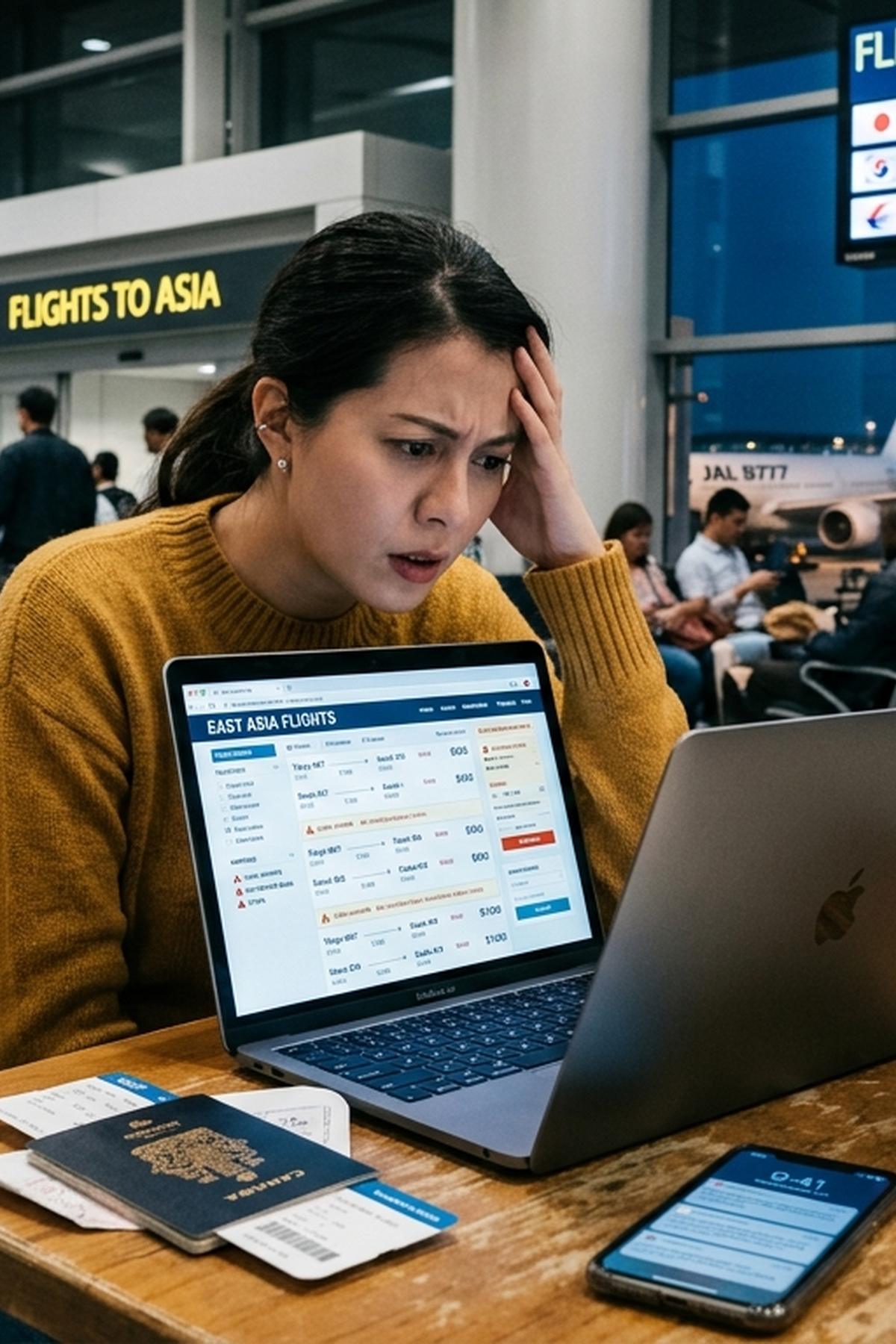
Price isn't the problem. The problem is that most travelers treat flight booking as a pure price optimization exercise and stop there. For a two-hour domestic hop, that logic holds up fine. For a 12-hour overnight flight in a seat with 29 inches of pitch, it becomes the kind of decision you regret somewhere over the Pacific, hours before you even land.
Flight Reality Check
- Sorting by price alone works for short flights. It consistently fails on 10 to 14 hour routes to Japan, China, and Singapore.
- Route network gaps can add four to six hours to a journey even when the headline fare looks competitive.
- Fleet age and aircraft type directly affect seat pitch, cabin pressure, humidity, and noise, all of which compound over a long flight.
- Looking up the specific aircraft assigned to your route before booking is the single most useful step most independent travelers skip.
- Budget carriers make sense on specific East Asia routes, but only under conditions most travelers never stop to verify.
Why the Sort-by-Price Habit Breaks Down on Long-Haul Routes
Independent travelers heading to Japan, China, or Singapore tend to be thorough about almost everything. They read neighborhood breakdowns before booking accommodation. They compare SIM card options and transit apps. They know which payment methods work in which cities. But flights consistently get a sort-by-price treatment, a booking confirmation, and no further research.
The cost of that shortcut is not abstract. Arriving in Tokyo or Singapore already depleted because you spent 14 hours in a cramped seat on a poorly configured aircraft isn't a minor inconvenience. It consumes your first one to two days of the trip. For travelers on tight budgets running lean itineraries, losing those days to recovery isn't a luxury problem. It's an operational failure that directly undermines the trip you spent months planning.
The correction isn't complicated. It requires applying the same level of scrutiny to carrier selection that experienced independent travelers already apply to accommodation and logistics. Price is one variable. It's not the only one that matters on a 10 to 14 hour transoceanic route, and treating it as the only one is where most people go wrong before they've even packed.
Route Networks Have Gaps That Budget Carriers Won't Highlight
A common assumption is that all airlines flying between the same two cities are offering essentially the same journey at different price points. That's accurate for some routes and completely wrong for others.
Full-service carriers on major Asia routes tend to operate nonstop or connect through large, well-organized hub airports with strong transit infrastructure. Budget and lower-tier carriers often route through secondary hubs or add connections that aren't immediately obvious from a fare comparison screen. A flight that appears to take 14 hours can become a 19 to 20 hour trip once you include a three-hour layover at an airport without adequate facilities, a terminal change with no airside connection, or a timed gap between flights that's long enough to be exhausting but not long enough to justify leaving the terminal.
Tokyo alone has two main international airports: Narita and Haneda. They serve different parts of the metropolitan area and are roughly an hour apart by transit under normal conditions. Shanghai also has two major airports. A budget fare that routes you into Narita for a connection looks similar to a fare into Haneda on a map, but on the ground, that difference reshapes your entire first day.
This matters particularly for travelers planning to continue to secondary cities in China or Japan after landing. A carrier with a competitive trans-Pacific fare but thin domestic Asia coverage may get you to Beijing at a good price, then leave you patching together the onward leg to Chengdu or Guilin through separate bookings, separate baggage claims, and separate check-in queues. That's a risk the headline fare price never includes.
Fleet Age Is a Real Variable, Not Just Aviation Trivia
Newer aircraft generally mean more comfortable long-haul travel, but the relationship isn't simply that older is bad. Some carriers maintain older fleets in excellent condition. A 15-year-old Boeing 777 operated by a disciplined full-service carrier can be a significantly more comfortable experience than a newer aircraft operated by a carrier that treats maintenance as a cost center.
The more important distinction is aircraft generation. Older widebody jets typically cabin-pressurize to an equivalent altitude of around 8,000 feet. Newer generation aircraft, particularly composite-fuselage designs like the Boeing 787 and Airbus A350, achieve lower cabin altitudes in the range of 6,000 feet, with higher humidity levels as a result. The difference is documented in the aircraft's own design documentation and translates to measurably less fatigue and dehydration on arrival after a 12-hour flight.
Across a single two-hour flight, those differences barely register. Across a 12-hour overnight route, they define how functional you are when you step off the plane. This is not a consideration exclusive to premium cabin passengers. Economy travelers on a newer-generation aircraft experience the same cabin environment benefits as passengers in business class on an older aircraft type.
How to Find Out What Aircraft Actually Flies Your Route
Most booking platforms list aircraft type somewhere in the flight details, but it's often buried in small print or abbreviated in ways that require interpretation. The more reliable approach is to check directly before committing to a fare.
Cross-referencing airlines and fleets by carrier gives you a clear picture of which aircraft a specific airline actually deploys on trans-Pacific and long-haul Asia routes, including the seat configuration for each aircraft type they operate. This is the information that determines whether you're buying a seat on a modern widebody with decent pitch or on an older, more tightly configured aircraft that will leave you stiff before you cross the International Date Line.
Once you have the aircraft type confirmed, you can cross-check the seat map for that specific flight. The same aircraft model can be configured very differently between carriers. A Boeing 777 in economy on one airline might offer 32 inches of pitch in a 3-3-3 configuration. On another, it might show the same pitch number but in a 3-4-3 layout, which makes the middle seat a genuinely miserable experience on an overnight flight. This information is publicly available. It takes less than ten minutes to check before you lock in a non-refundable fare.
Why Seat Pitch Feels Different After Hour Eight
The gap between 30 and 34 inches of seat pitch doesn't sound significant on paper. In practice, across a 12-hour overnight flight, it determines whether you arrive capable of functioning or whether you need a full day before you can do anything useful.
Economy pitch on full-service carriers on major Asia routes typically runs between 31 and 34 inches. Budget carriers and lower-cost configurations on the same transoceanic routes often land at 28 to 31 inches. For a traveler under 5'8", the lower end is genuinely uncomfortable over a full night flight but physically manageable. For taller passengers, it crosses into genuinely painful territory around hour six and stays there.
Beyond pitch, the physical design of the seat matters in ways the numbers don't capture. Some aircraft configurations place the in-flight entertainment screen in the seat back directly in front of you, which reduces usable legroom further when the passenger ahead reclines. Others mount screens in the armrest, preserving your space entirely regardless of what happens in the row in front. Seat width, lumbar support quality, and headrest adjustability all vary significantly between aircraft types and carrier configurations. None of this appears in a price comparison. All of it is findable before you book.
When Budget Carriers Are the Right Call on Asia Routes
Budget carriers are not automatically the wrong choice for East Asia travel. There are specific conditions where they represent a genuinely smart operational decision.
Daytime flights under eight hours are the clearest case. If you're flying Singapore to Tokyo or Hong Kong to Tokyo on a morning departure, the comfort trade-offs are manageable. You're not trying to sleep through the flight. You're awake, you can move around, and the lower seat pitch is an inconvenience rather than a physical toll. The fare savings on these routes can be substantial, and the comfort differential matters far less than on an overnight crossing.
Intra-Asia legs are another strong use case. Tokyo to Seoul, Singapore to Bangkok, or Hong Kong to Taipei are two to three hour segments where the difference between budget and full-service is minor and the price gap is often significant. These are routes where a budget carrier makes genuine operational sense.
Flexible timing also changes the calculation. Budget carriers operating fewer frequencies per week on a given route carry higher disruption risk if something goes wrong. If your itinerary has tight connections or limited buffer days, that risk compounds meaningfully. If you're traveling with genuine schedule flexibility and can absorb a delay or involuntary schedule change, the lower fare is a more justifiable trade-off.
When Paying More for Full-Service Is the Operationally Sound Call
For overnight transoceanic flights of 10 to 14 hours, the cost-benefit calculation shifts significantly in favor of full-service carriers. Your ability to function on arrival in Tokyo, Shanghai, or Singapore depends heavily on the sleep quality you get in the air. That quality is directly shaped by seat configuration, cabin environment, and the aircraft type you're on for those 12 hours.
Full-service carriers on trans-Pacific routes typically include checked baggage, meal service, and seating configurations that allow for actual rest on overnight flights. These aren't amenities aimed at premium travelers. They're operational inputs that affect what you can do when the wheels touch down on the other side of the planet.
The total cost calculation also deserves a closer look before you assume the budget option is cheaper. A budget fare that requires a paid checked bag at USD 60 to USD 100 each way, combined with a meal purchase during the flight and a connecting stop that adds four hours to your journey, may end up costing more in real terms than a full-service fare that includes baggage, meals, and a nonstop route. Running the actual numbers rather than comparing headline fares is a basic step that many independent travelers skip because the booking screen is designed to make the cheaper option look obviously cheaper.
If you're building toward frequent flier status or redeeming points, budget carriers typically don't participate in major alliance programs. The earning potential on a long transoceanic segment is meaningful. On a full-service carrier, that same flight can generate enough miles to cover a significant portion of a future intra-Asia leg, which is real value that disappears entirely on a budget booking.
The Decision That Defines How Your Trip Begins
Every experienced independent traveler in Asia has a version of this story. A cheap fare looked irresistible on a booking screen. The details didn't get checked. The aircraft turned out to be an older, tightly configured aircraft with 28-inch pitch and minimal recline. Fourteen hours later, the traveler stepped off the plane in no condition to start the trip they had spent months planning.
The money saved on the ticket didn't disappear. It just got redirected into a nicer hotel room to recover in, extra meals that day, or a first day written off to fatigue before the trip properly began. For a budget traveler, that's a terrible trade. You optimized the booking screen and paid the difference in a currency that doesn't show up in the fare comparison.
The correction here doesn't require spending more on every flight. It requires spending five to ten more minutes on research before every long-haul booking. Check the full route for hidden connections. Check the aircraft type before you confirm. Understand what the seat configuration means for your specific route length and departure time. A non-refundable ticket at a great price is only a great deal if the flight itself doesn't undermine everything that comes after it. That's a five-minute check, not a complicated one.
Read next
-
 The Honest Cost of Mobile Data in Japan, China, and Singapore
Real price data for SIMs, pocket WiFi, and eSIMs in Japan, China, and Singapore. Plus the friction points most travel guides quietly skip.
The Honest Cost of Mobile Data in Japan, China, and Singapore
Real price data for SIMs, pocket WiFi, and eSIMs in Japan, China, and Singapore. Plus the friction points most travel guides quietly skip.
-
 Fifth Freedom Flights Are the Award Sweet Spot Nobody Searches For
Fifth-freedom flights let you fly a foreign airline between two other countries, and they often have award seats when the airline's own hub routes are sold out.
Fifth Freedom Flights Are the Award Sweet Spot Nobody Searches For
Fifth-freedom flights let you fly a foreign airline between two other countries, and they often have award seats when the airline's own hub routes are sold out.
-
 Every Way Into an Airport Lounge and What Each One Actually Costs You
-
 When a Mileage Upgrade Is the Wrong Way to Spend Miles
Upgrading a paid ticket with miles sounds efficient but the required fare class often costs so much that a straight award booking in the same cabin is cheaper.
When a Mileage Upgrade Is the Wrong Way to Spend Miles
Upgrading a paid ticket with miles sounds efficient but the required fare class often costs so much that a straight award booking in the same cabin is cheaper.