Sha Tin, New Territories: Temples, Horses and the New Town Experiment
Sha Tin pairs a steep path to ten thousand golden Buddhas with a racecourse and the reality of a New Territories new town.
- Flag
-
- ISO code
- HK
- Population
- 690,000
Sha Tin: a Planned Answer to a Chaotic City
Kowloon's neon signs fight for air. Its pavements are a river of bodies moving at three different speeds. You liked it but you need a breath. Sha Tin is that breath, and it is nothing like the rest of Hong Kong. Built from scratch on reclaimed farmland starting in 1973, this new town of 630,000 people was designed as an alternative to the dense, organic sprawl of Kowloon and Hong Kong Island. It has a river walk, a cycle path that runs 11 kilometres to Tai Po, a racecourse that holds 85,000 people, and a hillside temple with 12,800 Buddha statues at the top of a 430-step climb. The question is not whether you should go. The question is what you will do with a day that requires no ferry, no harbour crossing, and no queue for a tram.
The Climb to Ten Thousand Buddhas Monastery
Before You Start the Climb
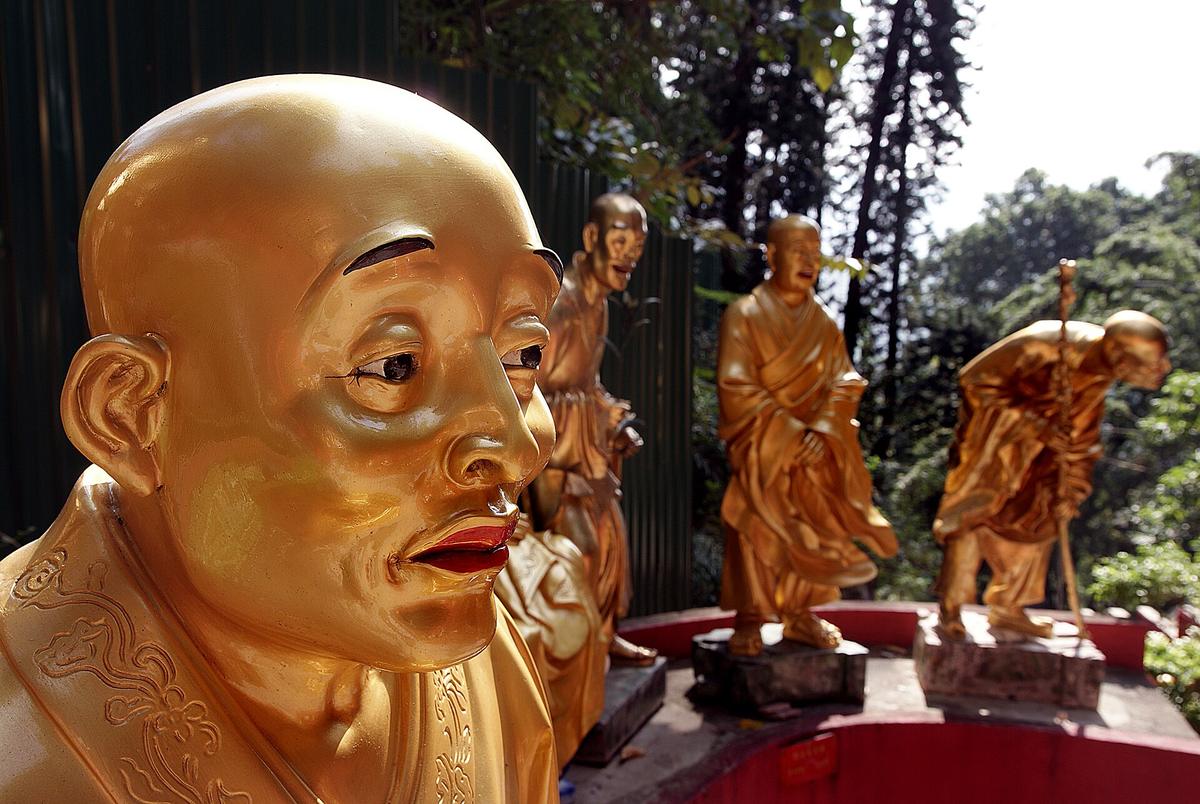
Start early. Arrive at Sha Tin MTR by 08:30, leave through Exit B, and walk 20 to 25 minutes to Pai Tau Village. The path is a concrete stairway flanked by 500 gilded arhat statues, each one in a different pose, and the climb gives you 430 steps of exposure to the morning heat. Bring water. There is none on the path. Watch for monkeys. They will snatch food and plastic bags. The temple was founded in 1951 by Yuet Kai, and its main hall holds a gilt Buddha beneath a nine story red pagoda you can climb. The claim of 12,800 Buddha statues sounds like a marketing number until you start counting the tiny figures lining every shelf. Photography is allowed. Admission is free. The vegetarian restaurant that used to serve lunch has been closed since 2020, so eat before you come or wait until you descend.
Finding It and Timing It Right
The signage from Sha Tin MTR is poor. Signs near Pai Tau Village may point you to a different temple entirely. Use Citymapper or HKeMobility, not Google Maps. If you lose the way, ask a local for "Man Fat Sze" in Cantonese. The temple opens at 09:00 and closes at 17:00, and the upper pagoda levels close earlier. Go up first, photograph the pagoda, then work your way down through the halls. You want to be back at street level by 11:00, before the tour groups arrive.

Horses, Heritage and the Riverfront
Race Day or Rest Day
The Sha Tin Racecourse opened on 7 October 1978 and holds about 85,000 people, though a Wednesday night meeting draws a fraction of that. The racing season runs September to July. Wednesday night races start around 19:15 and run until about 23:00. Saturday and Sunday day meetings begin at 13:00. Public enclosure admission costs a small fee, but that figure changes. The Hong Kong Jockey Club publishes the current rate. If you want the members' enclosure, bring your passport and buy a tourist badge, though that price is also annual. Minimum bet is low. Skip the betting if you do not understand it; watching the horses run the 1,000 to 2,400 metre tracks from the infield Penfold Park is more interesting than losing money on a quinella you cannot pronounce. Penfold Park is open to the public on non race days, 09:00 to 21:00, and it is the greenest spot in Sha Tin. On race days it is closed.
The Hong Kong Heritage Museum
A 15 minute walk from Sha Tin MTR, this five floor museum opened on 16 December 2000. The permanent galleries are free. Wednesday admission is also free. Closed Tuesdays. The second floor holds the Bruce Lee gallery, opened in 2013, with over 600 items including his yellow jumpsuit from Game of Death. The Cantonese opera gallery is on the same floor and is quiet, air conditioned, and almost never crowded. Budget 90 minutes. The special exhibitions charge a small fee, but the permanent collection is enough for most visitors. Che Kung Temple MTR is a 5 minute walk away if you arrive by train.
The Shing Mun River Corridor
The Shing Mun River was a tidal estuary until the 1970s, when it was channelised to drain the new town. Now it runs 7 kilometres through Sha Tin, lined with a continuous footpath and cycle track. Rent a bike from Sha Tin; shops set their own rates, so check the board outside before you hand over cash. Ride the 11 kilometres north to Tai Po. The path is paved, mostly flat, elevation gain under 30 metres. It follows the river, then Tolo Harbour, past the Science Park at Pak Shek Kok. One way rental is possible in Tai Po. The ride takes about an hour at an easy pace. Alternatively, walk the promenade from Sha Tin Park to the rowing centre and watch the dragon boat teams train. The Tuen Ng Festival races happen in May or June.
The New Town Experiment, Up Close
The Blueprint in Concrete
Sha Tin was designed for 600,000 people. It now holds 630,000. About 60 percent live in public housing; 40 percent in private estates. The first public estate was Lek Yuen Estate, completed 1975. The first private estate was City One Shatin, completed 1981, with 52 blocks and about 10,600 units. Walk through City One Shatin and you see the experiment at scale: everything you need within a 10 minute walk, schools, clinics, markets, bus stops, all connected by covered walkways. It works. It is also relentlessly beige.
Malls, Markets and a Temple
New Town Plaza, opened in the 1980s and expanded since, holds over 350 shops across Phase 1, Phase 3 and Grand Central Plaza. It is a five minute walk from Sha Tin MTR Exit A. The rooftop has Snoopy's World, opened in 2000, a free Peanuts themed play area open 11:00 to 19:00. If you have children it is a good break. If you do not, skip it. The music fountain at Phase 1 is not worth waiting for.
For food, head to the Sha Tin Market at 1 3 Sha Tin Centre Street. The cooked food centre on the upper floor has about 20 stalls. It opens around 06:00 and closes around 20:00. Cash only. The wonton noodle soup is good. The roast goose is adequate. This is not the destination for a meal you will remember. Sha Tin is bad at destination dining. You eat here because you are here.
Che Kung Temple, a 10 minute walk from Che Kung Temple MTR or Tai Wai MTR, is a rebuilt Song dynasty general temple completed in 1994. Turn the fan wheel three times for good luck. It is free. The busiest days are the second and third day of Chinese New Year, when over 100,000 visitors come. Go on a normal weekday and you will share the courtyard with a dozen people.
A Rock, a Train, and How to Leave
Amah Rock, a 15 metre rock formation in Lion Rock Country Park that resembles a woman carrying a baby, is visible from parts of Sha Tin. The hike from Hung Mui Kuk Road takes 30 to 45 minutes, moderate uphill on dirt and stone steps. The view looks over Sha Tin and the Shing Mun Valley. Do not go out of your way for it. If you are already cycling the river path and want a short climb, it works. If you have one day, skip it.
The East Rail Line connects Sha Tin MTR to Hung Hom in 15 minutes, Admiralty in 25 minutes, and the Lo Wu boundary with mainland China in 30 minutes. Fares to Central and Tsim Sha Tsui are set annually by the MTR Corporation; check the ticket machine on the day. Trains run every 2 to 3 minutes at peak. The stop opened in 1910 as part of the original Kowloon Canton Railway. Four platforms, four exits. Use Exit A for New Town Plaza. Use Exit B for the temple and the taxi rank.

What Sha Tin Does That No Other Hong Kong District Does
Sha Tin gives you a planned 1970s new town, a hillside temple with 12,800 Buddhas, a racecourse that holds 85,000 people, a free museum with Bruce Lee's jumpsuit, and a 7 kilometre river cycle path, all within a 25 minute MTR ride from Admiralty. It also gives you mediocre food, poor signage to its best attraction, and a distinct lack of evening energy after the racecourse closes. That is the trade off. You come to Sha Tin for the space, the cycle path, and the sight of a city that built order out of mudflats. You do not come for the nightlife.
Book the morning for the temple. Eat a packed lunch. Spend the afternoon on the river. If it is a Wednesday or a weekend, end at the racecourse with a cheap entry ticket and watch the horses run under floodlights. If it is not a race day, rent a bike and ride to Tai Po. The last train back to Admiralty leaves Sha Tin MTR at 00:50. You will be back in your hotel before midnight, and you will have seen a Hong Kong that most visitors miss entirely.
Common Questions
Is the Ten Thousand Buddhas Monastery worth the climb?
Yes, if you arrive by 09:00 and go straight to the pagoda. The 430 steps are concrete with handrails in parts, but the path is exposed and there is no water. The 500 gilded arhat statues along the stairway make the climb itself the attraction. If you are unfit or the temperature is above 32°C, skip it. The interior halls are less impressive than the path.
Can I visit the racecourse without betting?
Yes. The public enclosure costs a small fee, an annual figure set by the Hong Kong Jockey Club. You can watch the races from the infield Penfold Park on non race days, or from the public stands on race days. No one will make you bet. The atmosphere on a Wednesday night is casual and considerably quieter than a Saturday derby.
How do I get from Sha Tin to Tai Po by bike?
Rent a bike in Sha Tin; individual shops set their own rates, which change annually. Follow the Shing Mun River promenade north for 11 kilometres. The path is paved and flat. One way rental is possible at Tai Po. Budget one hour at easy pace.
What is Sha Tin bad at?
Destination dining. The cooked food centre at Sha Tin Market is functional, not memorable. There is no high end Cantonese restaurant worth a detour. The vegetarian restaurant at the temple has been closed since 2020. Eat before you arrive or plan a simple meal at the mall food court.
Is one day enough for Sha Tin?
One full day is enough for the temple, the heritage museum, a river walk, and either the racecourse (on a race day) or the cycle path. Two days allows for both the racecourse and the cycle ride, plus a hike to Amah Rock. Sha Tin is not a multi day base unless you are visiting family or have business in the New Territories.
Read next
-
 Hong Kong eSIM and Data Plans Before You Land
Hong Kong has no internet firewall. A cheap eSIM or tourist SIM from the airport gives you fast data for Google Maps and WhatsApp from the moment you land.
Hong Kong eSIM and Data Plans Before You Land
Hong Kong has no internet firewall. A cheap eSIM or tourist SIM from the airport gives you fast data for Google Maps and WhatsApp from the moment you land.
-
 Hong Kong Hotels by Price Band and Property Type
Hong Kong hotel rooms are small, but the difference between a luxury harbour-view tower and a Mong Kok budget room is enormous.
Hong Kong Hotels by Price Band and Property Type
Hong Kong hotel rooms are small, but the difference between a luxury harbour-view tower and a Mong Kok budget room is enormous.
-
 Where to Stay in Hong Kong Island or Kowloon for a First Visit
Hong Kong Island puts you in the financial and dining core, while Kowloon gives you harbour views and street life. The street you pick matters more than the district.
Where to Stay in Hong Kong Island or Kowloon for a First Visit
Hong Kong Island puts you in the financial and dining core, while Kowloon gives you harbour views and street life. The street you pick matters more than the district.
-
 How to Find Cheap Flights to Hong Kong International Airport
Hong Kong has one airport, a lot of airline competition, and a fast train into the city. The routing tricks are in the booking, not the arrival.
How to Find Cheap Flights to Hong Kong International Airport
Hong Kong has one airport, a lot of airline competition, and a fast train into the city. The routing tricks are in the booking, not the arrival.
-
 Things to Do in Hong Kong Ranked by What Is Worth Your Time
Victoria Peak, the Star Ferry, and a serious hike earn their fame. Some other Hong Kong sights do not.
Things to Do in Hong Kong Ranked by What Is Worth Your Time
Victoria Peak, the Star Ferry, and a serious hike earn their fame. Some other Hong Kong sights do not.
-
 Best Time to Visit Hong Kong for Clear Skies and Low Humidity
October to December offers the best balance of clear skies and low humidity, but every other season trades weather for lower prices or festivals.
Best Time to Visit Hong Kong for Clear Skies and Low Humidity
October to December offers the best balance of clear skies and low humidity, but every other season trades weather for lower prices or festivals.
-
 Sai Kung
 is a fishing town with a seafood street in front and the best coastline in Hong Kong behind it.
Sai Kung
Sai Kung is a fishing town with a seafood street in front and the best coastline in Hong Kong behind it.
-
 Victoria Peak
The view from Victoria Peak is the point; the tram queue is the problem, and there are four other ways up.
Victoria Peak
The view from Victoria Peak is the point; the tram queue is the problem, and there are four other ways up.
-
 Star Ferry
The Star Ferry costs HK$5, takes 10 minutes, and the upper deck heading from Tsim Sha Tsui to Central gives the best skyline view.
Star Ferry
The Star Ferry costs HK$5, takes 10 minutes, and the upper deck heading from Tsim Sha Tsui to Central gives the best skyline view.