Katong and Joo Chiat Are the East Coast Neighbourhood Worth Leaving the MRT Map For
The Peranakan east coast: terrace shophouses, laksa worth the trip out, and the closest Singapore comes to a residential neighbourhood a visitor seeks.
- Flag
-

- ISO code
- SG
- Currency
- SGD
Katong and Joo Chiat Are the East Coast Neighbourhood Worth Leaving the MRT Map for
At 08:30 on a Tuesday morning, Koon Seng Road is empty of cars and full of light. The shophouses run south in a disciplined pastel row: mint green beside rose pink beside lavender beside sky blue, their ceramic tiles glinting in the low-angle sun. You are the only person standing on the pavement. That is the moment this neighbourhood earns every minute of the journey it takes to get here.
Katong and Joo Chiat sit well east of the downtown core, at the far end of the Thomson-East Coast line. Marine Parade MRT station opened in June 2024 and drops you within a five-minute walk of the first shophouse terrace, but that station is the last stop on the line, 30 minutes from the city centre, and the trains run only until midnight. You are leaving the MRT map's dense centre and entering a part of Singapore that moves at a different speed. Budget time for that transfer, and budget time for the heat: the midday sun here punishes hard, and the area is spread out in a way that feels spacious until you are walking it. This is a morning or late afternoon excursion, not a stop you squeeze between lunch and a show.

The Shophouses That Set the Standard
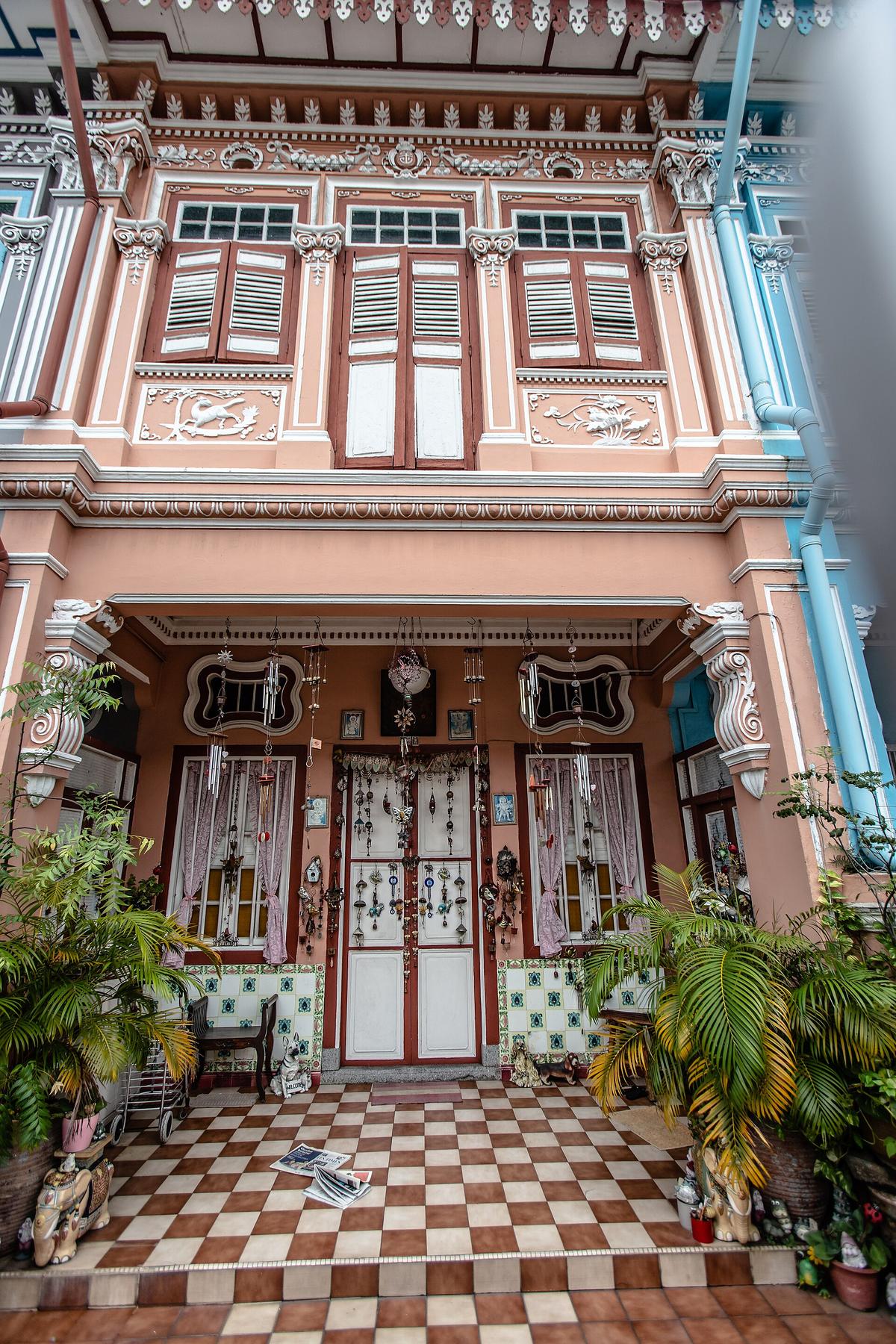
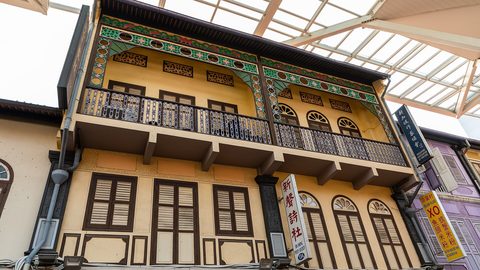
The terrace of preserved Peranakan Chinese Baroque shophouses at 1-55 Koon Seng Road, built in the 1920s and 1930s, is the single best concentrated example of this architectural style in Singapore. The pastel palette runs across the row: mint green, rose pink, lavender, sky blue and butter yellow. Each facade is encrusted with ceramic tiles, stucco mouldings, and window frames that flare outward at the top. Stand on the east side of the road for the full view. The sun is behind you in the morning, which means the facades catch the light instead of being washed out by it.
These buildings are private homes and do not have public ground-floor shops. That fact protects their quiet but also means you will feel intrusive if you linger too long. Take the photographs, walk the length of the row from the Joo Chiat Road end to the Still Road end, and move on. The surrounding conservation area, gazetted in 1993, contains more than 800 protected shophouses spread across Joo Chiat Road, East Coast Road, and the intersecting lanes. None of these secondary streets match Koon Seng Road for visual drama, but several reward a slow walk: try the stretch of Joo Chiat Road between Koon Seng and Tembeling Road, where the buildings are less polished and the ground-floor shops are still the ones the neighbourhood actually uses.
Laksa: the Dish That Defined the District
What Makes Katong Laksa Different
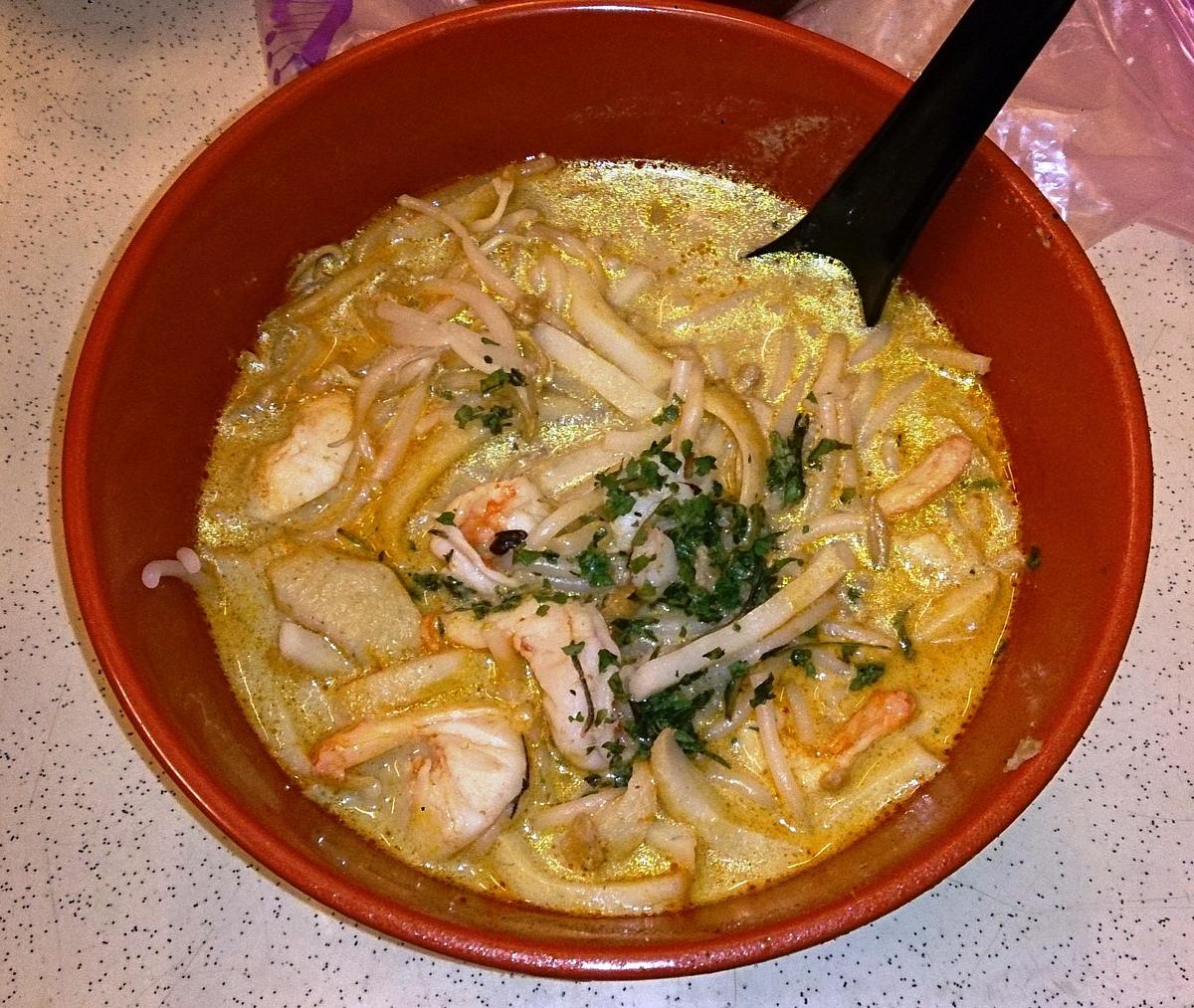
Katong laksa is not laksa as it is served elsewhere. The defining detail is the noodles: the rice vermicelli is cut into short lengths so that you never need chopsticks, only a spoon. The broth is a coconut-heavy gravy thickened with ground dried shrimp and rempah, and the toppings are prawns, cockles, fishcake, and hard-boiled egg. Every bowl is eaten with the spoon alone, fast and neat. That mechanical specificity is part of the point.
Which Stall to Choose
The stall to know is 328 Katong Laksa at 51 East Coast Road. It is the most famous version and the one most visitors try. The queue moves fast because the bowls are small and the turnover is high. Order one bowl, not two; the serving is modest but the coconut cream makes a second bowl heavy in the heat. The original Katong laksa claim belongs to Janggut Laksa, whose founder Ng Juat Swee began selling from a pushcart on East Coast Road in the 1950s. That stall now operates from Queensway Shopping Centre, outside Katong entirely, and the dispute about whose recipe is the real lineage is one the locals enjoy but you do not need to decide. A quieter option is Marine Parade Laksa at Blk 59 Marine Terrace, which is further east and less visited, or George's Katong Laksa at Blk 89 Marine Parade Central, which opens earlier than the others if you want lunch before the noon heat.
A Walking Route and What Fills it
The Morning Route, Step by Step
Do not attempt to see Katong and Joo Chiat as a single unbroken walk. The neighbourhood is linear, strung along East Coast Road, and the pavement is exposed to the sun for most of its length. Start at Koon Seng Road shophouse row at 08:30. Walk south down Koon Seng Road to East Coast Road, turn left, and head east toward the sea. The first stop is 328 Katong Laksa at 51 East Coast Road, a two-minute walk from the corner. After the bowl, cross East Coast Road to the other side and walk further east to 86 East Coast Road for Birds of Paradise gelato. The flavours are built around Southeast Asian ingredients: pandan, coconut, black sesame, chrysanthemum, white pepper. The texture is sorbet-light, which matters in the heat. Order one scoop in a cup, not a cone; the cone drips inside three minutes at 31 degrees.
The Kopitiam Pause
Continue east along East Coast Road to the junction with Joo Chiat Road. The area between these two roads and the parallel Still Road holds the quiet kopitiams that justify the detour from the busy spots. Look for a coffee shop with plastic stools, a worn floor, and a fan that does not reach the back tables. Order a kopi-O (black coffee with sugar) and sit for ten minutes without a phone. The distinction between this neighbourhood and the downtown core is legible in that pause: nobody is rushing, nobody is performing, and the only soundtrack is a television playing Chinese drama at low volume.
East Coast Park and The Intan
If you have energy after the coffee, continue east to East Coast Park. The coastal park runs 15 kilometres along the shoreline. The section closest to Katong, accessed via the pedestrian bridge at the end of East Coast Road, has a continuous paved cycling path and bike rental kiosks. This is not a beach in the Andaman sense; the water is the South China Sea shipping lane, and the sand is imported. But the park provides the sea breeze that the streets of Joo Chiat never catch, and after an hour of walking the shophouse neighbourhood you will want that relief.
For a very different version of the area, consider the Intan at 69 Joo Chiar Terrace. This is a private home museum housing roughly 5,000 Peranakan artefacts: jewellery, furniture, porcelain, beadwork. It requires a booking in advance, and visits run one to one and a half hours. There is an optional tea experience with Peranakan kueh. The limitation is that the owner, the collector Alvin Yapp, hosts each tour himself, which means only one group can visit per slot. Book 10 days ahead at minimum; on a last-minute trip, the chance of a free slot is close to zero.
Where Katong and Joo Chiat Are Weak
This area is bad at night. After 21:00, the streets are quiet, the kopitiams are closed, and the lighting is residential rather than atmospheric. There is a small cluster of bars on Joo Chiat Road, but they cater to a local crowd that arrives early and leaves by midnight. If you want evening energy, this is the wrong neighbourhood.
It is also bad for a tight schedule. A quick visit to see the shophouses and eat the laksa takes three hours minimum, including the 30-minute MRT journey each way. If you arrive after 11:00, the heat will compress your walking range and you will skip the minor streets that give the area its character. Treat this as a half-day commitment, not a quick detour.
Accommodation within the neighbourhood is predominantly boutique hotels, shophouse conversions, and serviced apartments. If you stay here, you trade the convenience of being on the MRT network's dense core for the experience of a quieter, more local patch of the city. Hotel Indigo at 86 East Coast Road is the most visible option, The Great Madras at 28 Madras Street is more characterful but noisier, and Village Residence Katong at 25 Marine Parade offers self-catering for families.

Peranakan Restaurants and How to Choose
The neighbourhood claims several Peranakan restaurants, and the price range varies sharply. Guan Hoe Soon at 38 Joo Chiat Place, established 1953, is the oldest in the city and the most reliable for a classic Peranakan lunch: ayam buah keluak (chicken stewed with black nuts), babi pongteh (pork belly in fermented soybean), and itek sio (braised duck). The dining room has not been modernised, which is part of its authority. Book a table for 11:30 and finish by 13:00 to avoid the lunch queue.
Baba Chews at Hotel Indigo, 86 East Coast Road, is the more accessible option serving a bistro-style take on the cuisine. The value proposition is lower: the same dishes cost roughly 40 per cent more than at Guan Hoe Soon. Peranakan Inn at 210 East Coast Road sits in the middle of the price range and has a larger menu, but the quality varies. If you have time for one meal, choose Guan Hoe Soon. If you are short on time, eat the laksa and call the culinary immersion done.
| Factor | Detail |
|---|---|
| Nearest MRT station | Marine Parade MRT (Thomson-East Coast Line), opened June 2024 |
| Alternative MRT access | Eunos MRT (East-West Line), 15-20 minute walk to Joo Chiat Road |
| Bus routes from city centre | 10, 12, 14, 16, 32, 40 |
| Best time to photograph shophouses | 08:00-10:00, sun behind you on Koon Seng Road |
| Avoid | 11:00-15:00 for walking; 21:00-07:00 for activity |
| Taxi to Marina Bay | Approximately 15 minutes off-peak |
| Conserved shophouses in Joo Chiat | Over 800, area gazetted 1 December 1993 |
Who This Neighbourhood Suits and Who Should Skip it
Katong and Joo Chiat suit the traveller who has already seen Marina Bay's skyline and Chinatown's temples and wants the Singapore that operates outside the tourist infrastructure. This is the neighbourhood for the person who values the spatial experience of a real place over the efficiency of a curated attraction list. It works for food travellers who will take a bowl of laksa over a Michelin-starred menu, and for photographers who want the shophouse row at 08:30 with no one else in frame.
Skip it if your Singapore time is limited to 48 hours or less. The MRT journey, the spread-out geography, and the heat penalty for arriving after 11:00 make this a poor investment for a stopover traveller. Skip it if you need evening entertainment that extends past 22:00. Skip it if you do not tolerate humidity well and refuse to carry a water bottle and a towel, because the gap between air-conditioned stops here is longer than in the downtown core and the consequences of dehydration arrive faster than you expect.
Other areas in Singapore
Common Questions
How much time do I need for Katong and Joo Chiat?
Plan for half a day, from 08:30 to 13:00 or 15:30 to 20:00. The area is cohesive but spread along East Coast Road, and the heat limits walking speed between 11:00 and 15:00. A rushed visit under two hours will only show you the shophouse terrace and one bowl of laksa, which misses the quiet kopitiams and the seaside park that give the neighbourhood its range.
Which laksa stall should I visit?
328 Katong Laksa at 51 East Coast Road is the most consistent and the most famous. The queue moves within 10 minutes. Order one small bowl and eat it with the spoon only. If you want the historical origin, Janggut Laksa is now at Queensway Shopping Centre, not in Katong. Marine Parade Laksa at Blk 59 Marine Terrace is the local alternative with a shorter queue.
Are the shophouses on Koon Seng Road open to the public?
No. They are private homes. You may photograph the facades from the pavement. The conservation area includes more than 800 protected shophouses, and some on Joo Chiat Road and East Coast Road have ground-floor shops and cafes you can enter, but the Koon Seng Road terrace is residential and should be treated with respect.
Is there anything to do in Katong after dark?
Very little. The area quiets after 21:00. A handful of bars on Joo Chiat Road operate until midnight, but the atmosphere is subdued. East Coast Park is lit and open to pedestrians and cyclists all night, but the food village closes by 23:00. This is not a nocturnal neighbourhood.
Can I visit the Intan without a reservation?
No. The Intan at 69 Joo Chiat Terrace is a private home museum and requires an appointment. Visits run 60-90 minutes. Book at least 10 days in advance. Same-day walk-ins are not accepted.
Is staying in Katong a good idea for a first-time visitor?
Only if you want quiet evenings and local food rather than proximity to the main sights. A taxi to Marina Bay takes about 15 minutes off-peak, and to Orchard Road about 20 minutes, but the MRT runs only until midnight and ride-hail prices surge after that. First-time visitors with less than three days should stay in the colonial core or Bugis and visit Katong as a half-day trip.
Why is the laksa served with a spoon and no chopsticks?
The rice vermicelli is cut into short lengths so the entire dish can be eaten with a spoon. This is the defining characteristic of Katong laksa and distinguishes it from other laksa varieties in Malaysia and Singapore. If you are given chopsticks, you are not eating Katong laksa.
Read next
-
 Singapore eSIM, Tourist SIM Cards and Free Public Wi-Fi Compared
Singapore offers eSIMs, 100GB tourist SIM cards from S$12 at Changi, and free public Wi-Fi. The real essential is downloading Grab before you land, because setup requires an SMS code.
Singapore eSIM, Tourist SIM Cards and Free Public Wi-Fi Compared
Singapore offers eSIMs, 100GB tourist SIM cards from S$12 at Changi, and free public Wi-Fi. The real essential is downloading Grab before you land, because setup requires an SMS code.
-
 Singapore Hotels by Type and Budget Not by Neighbourhood
Singapore hotels sorted by property type and price band, skyline towers, shophouse boutiques, family chains, and transit sleepers, with honest notes on what S$400 actually buys here.
Singapore Hotels by Type and Budget Not by Neighbourhood
Singapore hotels sorted by property type and price band, skyline towers, shophouse boutiques, family chains, and transit sleepers, with honest notes on what S$400 actually buys here.
-
 Where to Stay in Singapore for Neighbourhood Character Not Just a Bed
Compare Singapore's neighbourhoods by the experience of waking up there, hawker breakfasts, shophouse streets, or skyline views, not by distance to a landmark the MRT erases.
Where to Stay in Singapore for Neighbourhood Character Not Just a Bed
Compare Singapore's neighbourhoods by the experience of waking up there, hawker breakfasts, shophouse streets, or skyline views, not by distance to a landmark the MRT erases.
-
 Flying Into Changi Airport Singapore and Making the Stopover Work
Changi Airport turns a Singapore stopover into a free mini-trip. How long you need to clear immigration, eat a hawker meal, and still make your connection.
Flying Into Changi Airport Singapore and Making the Stopover Work
Changi Airport turns a Singapore stopover into a free mini-trip. How long you need to clear immigration, eat a hawker meal, and still make your connection.
-
 Singapore Things to Do With Only Three Days and Brutal Midday Heat
Hard calls on which Singapore sights earn limited days: Gardens by the Bay and Botanic Gardens are non-negotiable, Sentosa is skippable, and everything bends around the 11am-to-3pm heat.
Singapore Things to Do With Only Three Days and Brutal Midday Heat
Hard calls on which Singapore sights earn limited days: Gardens by the Bay and Botanic Gardens are non-negotiable, Sentosa is skippable, and everything bends around the 11am-to-3pm heat.
-
 Best Time to Visit Singapore When One Degree From the Equator
Singapore sits one degree from the equator so temperature barely shifts, plan around monsoon rains, Chinese New Year hawker closures, haze season, and F1 hotel price spikes instead.
Best Time to Visit Singapore When One Degree From the Equator
Singapore sits one degree from the equator so temperature barely shifts, plan around monsoon rains, Chinese New Year hawker closures, haze season, and F1 hotel price spikes instead.
-
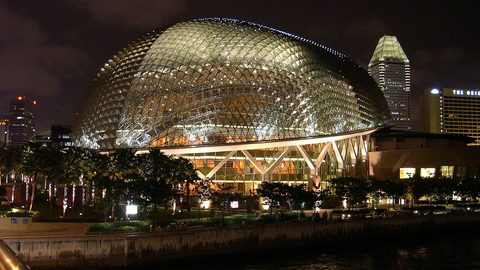 Civic District
Walk Singapore's colonial core from Raffles Hotel to the river, connecting the Padang, National Gallery, and Asian Civilisations Museum in one shaded morning route.
Civic District
Walk Singapore's colonial core from Raffles Hotel to the river, connecting the Padang, National Gallery, and Asian Civilisations Museum in one shaded morning route.
-
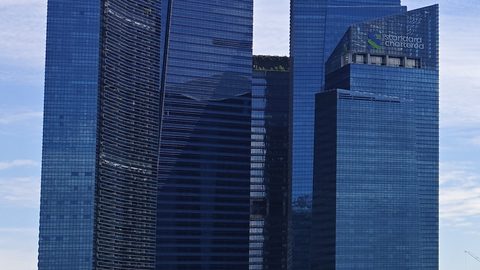 Marina Bay
 works best as a two-evening postcard loop, Supertree light show, SkyPark sunset, waterfront walk, not as a base. Sleep somewhere with hawker centres instead.
Marina Bay
Marina Bay works best as a two-evening postcard loop, Supertree light show, SkyPark sunset, waterfront walk, not as a base. Sleep somewhere with hawker centres instead.
-
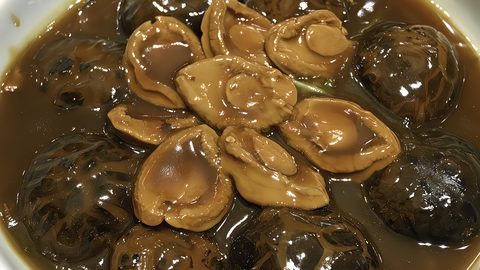 Dempsey Hill
 has no MRT station by design, turning a former British barracks into a green, quiet, upscale dining enclave above Orchard Road.
Dempsey Hill
Dempsey Hill has no MRT station by design, turning a former British barracks into a green, quiet, upscale dining enclave above Orchard Road.