A Guide to Buddhist, Daoist, and Muslim Beijing Temples
A guide to Beijing's Buddhist, Daoist, and Muslim temples, and the three that give the best sense of the city's religious life.

The Beijing Temple Guide That Most Visitors Miss
Most people arrive in Beijing expecting a city draped in incense smoke and ancient stillness, a kind of Buddhist theme park. That is wrong. The religious sites here do not form a tidy circuit of photogenic wooden halls like Kyoto or Luang Prabang. The real distinction is religious tradition. Most of what you will find is Tibetan Buddhist, Han Buddhist, Daoist, Muslim, Confucian, or Catholic, and each one behaves completely differently. The atmosphere, the dress code, what you are allowed to photograph, whether you can even enter the prayer hall. These are not interchangeable.
The scale of Beijing works against you here. The Lama Temple is in Dongcheng. The Temple of Heaven is a 30-minute metro ride south. The White Cloud Temple is another 20 minutes west. A first-time visitor who tries to do all three in one morning will spend more time underground than inside any of them. You need a plan that groups by geography and by what each place actually offers you as a traveller.
Three sites, three traditions, one dense day. That is the maximum a newcomer should attempt. The three are the Lama Temple (Tibetan Buddhist, active, loud with incense), the Temple of Heaven (Ming imperial altar, not a temple, best at dawn with the locals), and the White Cloud Temple (Daoist, quiet, odd stone monkeys). If you want a fourth option that is not Buddhist or Daoist, swap the White Cloud Temple for the Niujie Mosque. You get three distinct architectural and ritual vocabularies inside a single walkable area of central Beijing, and nothing else comes close to that efficiency.
The Three to Pick and Why
Lama Temple: The Active Tibetan Buddhist Experience
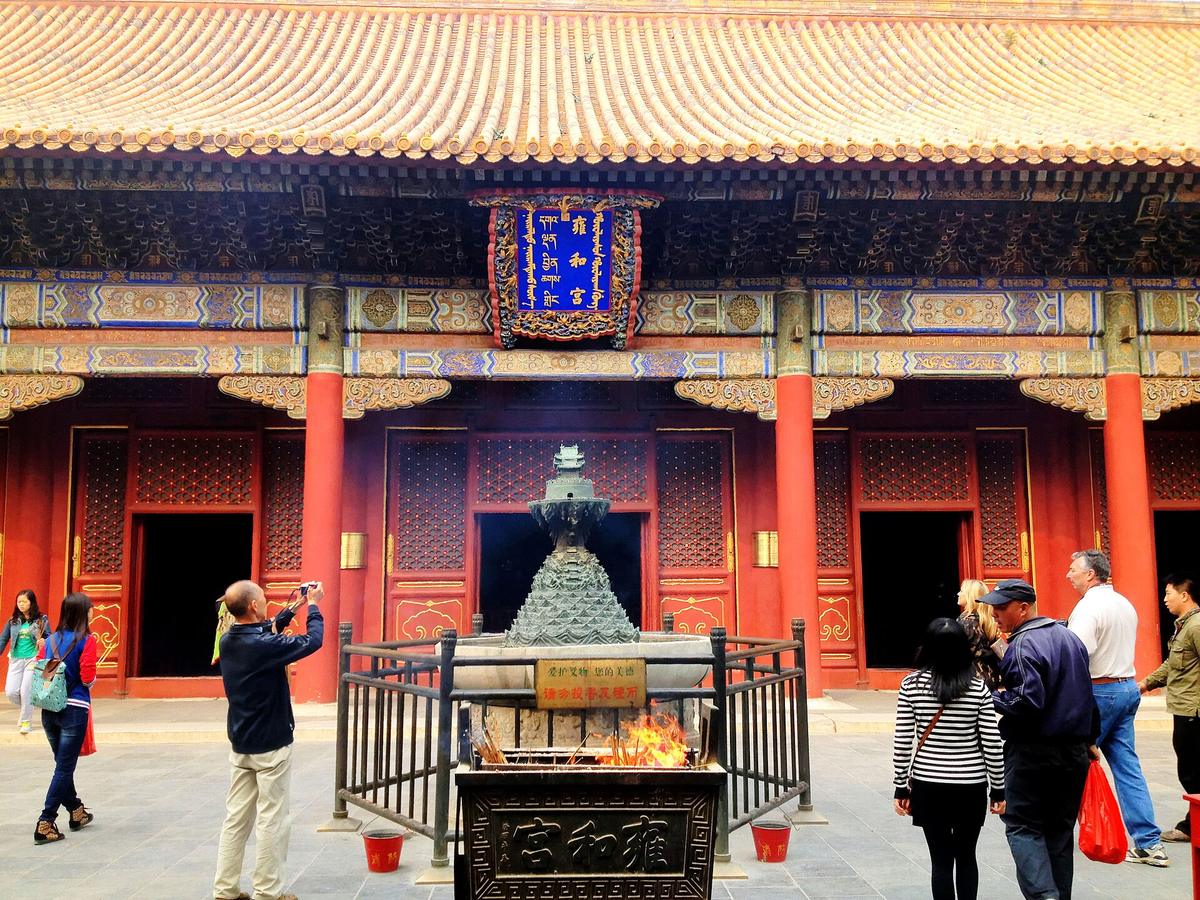
This is the one religious site you do not skip. The Yonghe Temple, which everyone calls the Lama Temple, was originally the residence of Prince Yongzheng, converted to a lamasery of the Gelug school in 1744. It sits in Dongcheng District, directly beside the Confucius Temple and the Imperial College, so you can bag three sites on one walk. Buy admission at the gate, and arrive by 08:30 before the tour groups fill the main halls. The incense is thick. Monks chant in the prayer halls. You will see real practitioners prostrating, not just tourists posing.
Photography is banned inside the prayer halls and in front of consecrated images. Shoot in the courtyards and you will be fine. Dress with shoulders and knees covered, and remove your hat before entering any hall. The key threshold rule: step over the raised door sills, never on them. If you visit only one religious site in Beijing, this is it. The scale, the active practice, and the proximity to the Confucius Temple and the Imperial College make it the most efficient use of your morning.
Temple of Heaven: The Ming Imperial Altar With Morning Park Rituals
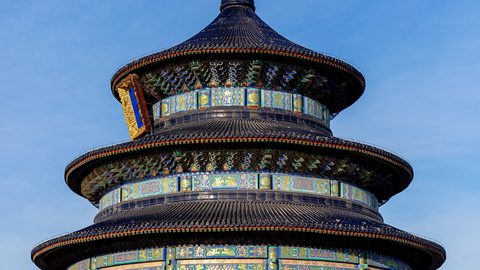
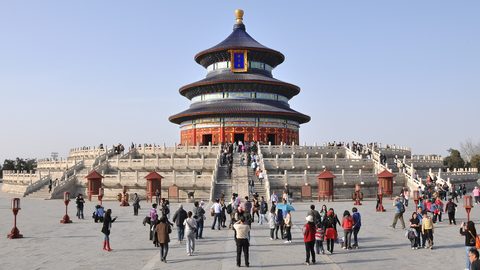
The Temple of Heaven is not a temple. It is an altar complex where Ming and Qing emperors performed the annual harvest sacrifice. Do not come for the religious experience. Come for the architecture (the Hall of Prayer for Good Harvests is the image on every Beijing postcard) and for the morning park life that happens outside the ticket barriers. Locals practice tai chi, play traditional instruments, sing opera, and fly kites in the surrounding park from about 06:30. The site opens at 06:00. Enter through the south gate to walk the straight line of the altar axis, and exit through the north gate into the park. Budget 2.5 hours for the inner walled sections and another 45 minutes for the park. The echo walls and the circular mound altar are worth the separate ticket. You need ¥35 for the full ticket versus ¥15 for the park only, and the full ticket is correct for a first timer.
White Cloud Temple Or Niujie Mosque: Quieter, More Local
The White Cloud Temple (Baiyunguan) belongs to the Quanzhen school of Daoism and was founded in 739 CE. It is still active as an ordination centre. Three stone monkeys are hidden around the grounds, and locals rub them as a custom. The place is quieter than the Lama Temple by a wide margin. Fewer crowds, less incense, more empty courtyards. Go here if you want to feel a community that has not been overwhelmed by tourism. The annual New Year fair happens here. Outside that period, the atmosphere is subdued. Photography rules match the Lama Temple: permitted in courtyards, banned in halls. The same dress code applies.
The alternative is the Niujie Mosque in Xicheng District, on Ox Street. It is over 1,000 years old, founded in 996 CE, and built in Chinese courtyard form with Islamic calligraphy woven into the roof beams. Non-Muslims cannot enter the prayer hall. The courtyard and the architectural details are visible from the entrance. The surrounding Ox Street neighbourhood is a Muslim quarter with some of the best lamb hotpot and tripe in Beijing. If you do the Niujie Mosque instead of the White Cloud Temple, your three traditions become Tibetan Buddhist, Confucian imperial ritual, and Chinese Islamic, which is a stronger spread for most travellers. Choose the White Cloud Temple if you want Daoist ritual. Choose the Niujie Mosque if you want to eat well afterward.
What to Skip and How Not to Waste Your Day
Sites That Cost You More Time Than They Return
The Fayuan Temple is the oldest Buddhist site in Beijing, founded in 645 CE, and it is the working seminary of the Buddhist Academy of China. It is quiet and beautiful. Skip it unless you are a specialist. It is in the southwest of the city, away from the cluster of the three chosen sites, and the time cost of getting there and back is not justified for one quiet courtyard. The Confucius Temple and the Imperial College sit right next to the Lama Temple. Add them to your Lama Temple visit; do not treat them as a separate day. The 198 stone stelae inscribed with the names of palace examination graduates from three dynasties are worth 20 minutes of your time.
The Temple of Heaven is not where you go for Han Buddhism. It is where you go for state ceremony and morning park life. If you want Han Buddhist architecture, the Great Bell Temple (Dazhong Temple) holds the Yongle Bell cast between 1403 and 1424, inscribed with over 227,000 characters of Buddhist sutras. It is a remarkable object. It is also a 45-minute metro ride north of the centre and not near anything else you are likely to visit. Do it only if you have a third day free and a specific interest in bell casting.
The Dongyue Temple, a Yuan dynasty Daoist site dedicated to the Great Emperor of the Eastern Peak, contains 76 halls depicting underworld punishments in graphic detail. It is almost always empty. The art is fascinating and unsettling. Most travellers should skip it. The underworld imagery is intense and the site is out of the way unless you are already in the Chaoyang area. The Tanzhe Temple and the Jietai Temple are in the western hills, Mentougou District, and the founding claim. First there was Tanzhe, then there was Beijing. That is approximately correct from the Jin dynasty. They require a half-day car trip and are best combined with a drive to a Great Wall section. Do not attempt them on a short trip.
.jpg)
Dress Rules, Incense Etiquette, and What the Signs Actually Say
You will be turned away at the gate if your shoulders or knees are bare. A thin scarf tied around your shoulders does not count. Carry a long-sleeve shirt in your day bag regardless of the heat. Remove your hat before entering any hall. Step over the raised thresholds, not on them, at every entrance. This is not superstition. It is the practical reason that the thresholds have not been worn down by foot traffic, but the custom is taken seriously enough that guards will correct you.
Incense is lit only in designated areas. Do not bring outside incense into any site. The Lama Temple's front courtyard has a large burner where you can light sticks you buy there. Three sticks is the standard offering. Do not blow out the flame. Wave it gently until it extinguishes on its own. Do not toss lit sticks into the burner. Place them upright. If you do not want to make an offering, nobody will notice. You are never required to participate.
Photography rules are not flexible. No photos inside prayer halls. No photos of consecrated images. No flash in any covered area. The signs are in Chinese and English, but tourists ignore them and are then told to delete their images. Avoid the confrontation by keeping your phone in your pocket indoors. Courtyard photography is fine unless a sign explicitly prohibits it. The only exception is the Niujie Mosque, where photography of any interior, even the courtyard, may be restricted during prayer times. Ask before you raise your phone.
Read next
-
 Beijing Hotels by Price Band and Property Type
Beijing hotels split into hutong courtyards, international chains and functional business towers. Here is what each price band actually buys you.
Beijing Hotels by Price Band and Property Type
Beijing hotels split into hutong courtyards, international chains and functional business towers. Here is what each price band actually buys you.
-
 Where to Stay in Beijing by District and Travel Style
Dongcheng puts you beside the Forbidden City, Chaoyang beside the nightlife. Here is how Beijing's districts compare for different travellers.
Where to Stay in Beijing by District and Travel Style
Dongcheng puts you beside the Forbidden City, Chaoyang beside the nightlife. Here is how Beijing's districts compare for different travellers.
-
 Beijing Flights PEK vs PKX Which Airport Actually Works for You
PEK or PKX? What each Beijing airport costs you in time, money, and logistical friction depending on where you are staying.
Beijing Flights PEK vs PKX Which Airport Actually Works for You
PEK or PKX? What each Beijing airport costs you in time, money, and logistical friction depending on where you are staying.
-
 Beijing Things to Do Worth Your Limited Days
The Forbidden City and Great Wall are essential, but Beijing's meaning lives in temple courtyards, hutong lanes and food streets. Here is what earns your days.
Beijing Things to Do Worth Your Limited Days
The Forbidden City and Great Wall are essential, but Beijing's meaning lives in temple courtyards, hutong lanes and food streets. Here is what earns your days.
-
 Best Time to Visit Beijing, Month by Month Tradeoffs
April and October bring blue skies and queues, July brings heat, January brings empty sites and hazardous air. Here is Beijing month by month.
Best Time to Visit Beijing, Month by Month Tradeoffs
April and October bring blue skies and queues, July brings heat, January brings empty sites and hazardous air. Here is Beijing month by month.
-
 Getting Around Beijing Without Losing Half Your Day
Beijing's metro is clean and cheap but stops early, and taxis rarely speak English. Here is how to move around without burning half your day.
Getting Around Beijing Without Losing Half Your Day
Beijing's metro is clean and cheap but stops early, and taxis rarely speak English. Here is how to move around without burning half your day.
-
 Forbidden City
 tickets require booking seven days ahead on WeChat with a passport. Here is the route to take once you are inside to avoid wasting the visit.
Forbidden City
Forbidden City tickets require booking seven days ahead on WeChat with a passport. Here is the route to take once you are inside to avoid wasting the visit.
-
 Temple of Heaven
The Temple of Heaven park matters as much as the temple. Morning tai chi, choirs, and card players make it a Beijing ritual worth a full morning.
Temple of Heaven
The Temple of Heaven park matters as much as the temple. Morning tai chi, choirs, and card players make it a Beijing ritual worth a full morning.
-
 Summer Palace
The Summer Palace is vast and the wrong entrance adds an hour of walking. Use the East Palace Gate and plan for at least four hours.
Summer Palace
The Summer Palace is vast and the wrong entrance adds an hour of walking. Use the East Palace Gate and plan for at least four hours.