Why Singapore's Oldest Hindu Temple Stands in Chinatown, and How to Visit Sri Mariamman Properly
Sri Mariamman Temple, Singapore's oldest Hindu temple, sits in the middle of Chinatown, here is why, and what to know before you take your shoes off.
.jpg)
A South Indian Temple in the Middle of Chinatown
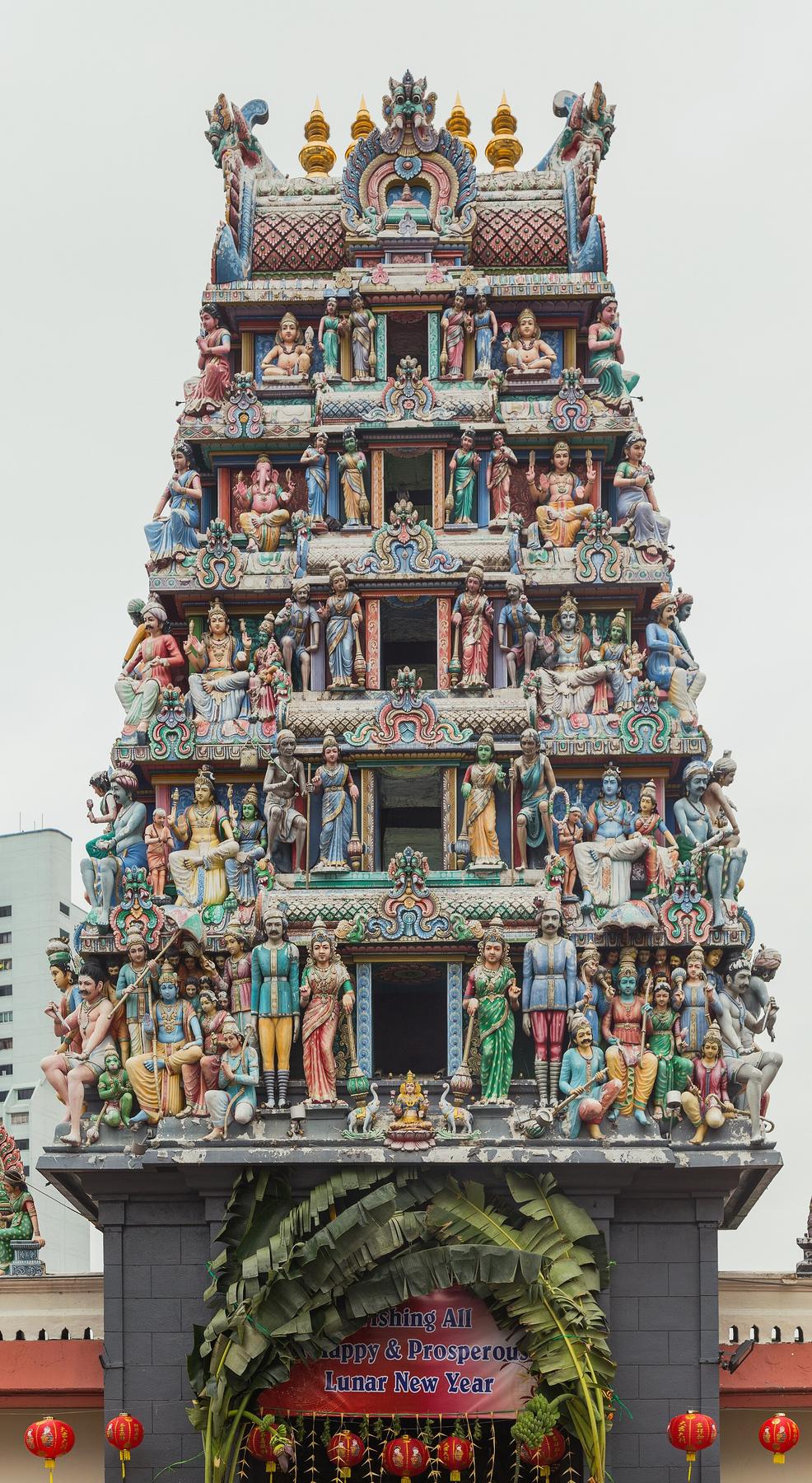
You are standing on Pagoda Street, surrounded by red lanterns and shophouses selling calligraphy brushes and silk fans, and ahead of you looms a 15-metre tower covered in dozens of painted Hindu gods. This is Sri Mariamman Temple, and the first question every visitor asks is the right one: what is a South Indian temple doing here? The Tamil community settled along South Bridge Road before the area became predominantly Chinese. The temple dates to 1827, founded by Naraina Pillai, a Tamil immigrant who built a private shrine that later expanded into a community temple. By the time the Chinese merchant population grew dense enough to rename the district, the temple had already stood here for decades. What looks like a contradiction is actually a timeline: Chinatown moved in around it, not the other way around.
Stop here, but for a specific reason. The gopuram, the entrance tower, is the most photographed single object in the neighbourhood. The five tiers of carved deities, mythological beings and scenes from Hindu epics are dense and strange and colourful. Give it a slow five-minute look. The interior courtyard is calm, shaded, and you can photograph freely. Skip a full circuit of the inner sanctum unless you are a practising Hindu. The main shrine of Sri Mariamman, the goddess of rain and disease, along with the subsidiary deities housed here, is reserved for devotees. Photography is restricted in the main prayer hall. Budget ten minutes for the exterior and courtyard; twenty if you want to sit and watch.
- Year Founded: 1827
- Admission Fee: Free
- Dress Code: Shoulders and knees covered
- Shoe Policy: Remove before entering
- Photography: Allowed in outer courtyard and gopuram exterior; restricted in main prayer hall and inner sanctum
- Opening Hours: 06:00-12:00 and 18:00-21:00 daily. Closed midday.
- Nearest MRT: Chinatown Station (NE4/DT19), Exit A onto Pagoda Street
- National Monument: Gazetted 6 July 1973
- Firewalking Festival: Theemithi, held annually in October or November (month of Aippasi)
How to Visit Without Making the Standard Mistake
Get the Timing Right
The standard mistake is to show up at 1pm. The temple closes from noon to 6pm every day. There is no air conditioning and little shade in the courtyard. You arrive, the gate is locked, and you have wasted a trip through the heat. The cash saving from skipping midday is real but secondary to the basic comfort of visiting when you can stand still for more than ninety seconds.
Arrive at 9am or 6pm. The morning slot gives you the cooler hours before the sun is overhead and a quieter courtyard. The evening slot coincides with the start of prayers. You will hear chanting and bells inside the hall even if you cannot enter. Neither time is crowded; the temple receives a steady trickle of worshippers and curious visitors, not a crush. Weekdays are quieter than weekends. Sunday morning sees a spike in families and devotees.
What to Wear and What to Expect at the Gate
Entrance is through the gopuram on Pagoda Street. Remove your shoes at the racks just inside the gate. No charge. No donation box. No ticket. The floor is stone and hot by late morning; wear shoes you can slip off easily and consider socks if you are sensitive to warm ground. Shoulders and knees must be covered. A shawl or scarf works for shoulders. Men in shorts will need to go down past the knee, or the volunteer at the gate will wave you back out.
What You Are Looking At
The gopuram was rebuilt in the 1930s, a 15-metre five-tier structure densely packed with figures. The deities sit at the centre and upper tiers; lesser figures and ornamental sculptures fill the lower levels and sides. Stand at the base and look up for a full minute. That one look yields more than walking a lap of the courtyard. The courtyard is small and the main building faces you directly. You will see the whole interior from the entrance step within thirty seconds.
Theemithi: the Firewalking Festival You Can Watch
Once a year, in October or November, the temple grounds host the only major firewalking ceremony in Singapore open to the public. Theemithi is a Tamil Hindu ritual in which devotees walk across a pit of burning coals. The full festival runs across several days, but the firewalk itself takes roughly twenty minutes. What matters for a visitor is the logistics: the walkers start at Sri Srinivasa Perumal Temple on Serangoon Road in Little India, process roughly four kilometres on foot through the streets, and end at Sri Mariamman Temple. The route is policed and the crowds are large. To see the actual firewalk, be at the Pagoda Street end, not the start. Arrive by late afternoon and prepare for dense heat and slow movement. The date shifts each year according to the Tamil calendar month of Aippasi. Check the Hindu Endowments Board website for the exact date in the year you are visiting.
What is Actually Nearby and What You Should Do After
The Best Pairing
You have fifteen minutes left after the temple. Walk southwest roughly 250 metres, about three to five minutes on foot, and you hit the Buddha Tooth Relic Temple. It is free, it is air conditioned, and it stays open through the midday hours that Sri Mariamman does not. The relic chamber is on the fourth floor and the rooftop garden offers a view over the neighbourhood. That is the best pairing for this part of Chinatown: one temple, then the other, then lunch.
Where to Eat
Maxwell Food Centre is two streets east. Tian Tian Hainanese Chicken Rice is the stall everyone queues for. The queue moves fast and the chicken rice is genuinely good, but if the line runs past fifteen people, the stall two spots down serves a version that is 90 percent as good with zero wait. This is not a food temple moment; it is a practical lunch stop before the heat drives you indoors.
Who Should Skip It
Skip Sri Mariamman if you have been to a Dravidian-style temple in Tamil Nadu, Malaysia, or even elsewhere in Singapore. This is a modest, urban version. If you have a week in Singapore and barely two afternoons free, pick the Buddha Tooth Relic Temple instead for its museum quality and climate control. If you have three full days, Sri Mariamman earns its ten minutes.
Common Questions
Do I need to pay to enter Sri Mariamman Temple?
No. Admission is free. There is no ticket booth, donation box at the entrance, or suggested fee. You walk straight in after removing your shoes.
Can I take photos inside the temple?
Yes in the outer courtyard and of the gopuram exterior. No in the main prayer hall and inner sanctum. The restriction is enforced by volunteers, not signage. Watch what other visitors do.
Is the temple open every day?
Yes, daily, but not continuously. Hours are 06:00 to 12:00 and 18:00 to 21:00. It is completely closed from noon to 6pm. Plan your arrival around either window.
When is the best time to see the firewalking festival?
Late afternoon on the day of Theemithi in October or November. The walkers arrive at Sri Mariamman Temple after processing from Little India. The exact date varies with the Tamil calendar. Check the Hindu Endowments Board website for the current year.
Read next
-
 Singapore eSIM, Tourist SIM Cards and Free Public Wi-Fi Compared
Singapore offers eSIMs, 100GB tourist SIM cards from S$12 at Changi, and free public Wi-Fi. The real essential is downloading Grab before you land, because setup requires an SMS code.
Singapore eSIM, Tourist SIM Cards and Free Public Wi-Fi Compared
Singapore offers eSIMs, 100GB tourist SIM cards from S$12 at Changi, and free public Wi-Fi. The real essential is downloading Grab before you land, because setup requires an SMS code.
-
 Singapore Hotels by Type and Budget Not by Neighbourhood
Singapore hotels sorted by property type and price band, skyline towers, shophouse boutiques, family chains, and transit sleepers, with honest notes on what S$400 actually buys here.
Singapore Hotels by Type and Budget Not by Neighbourhood
Singapore hotels sorted by property type and price band, skyline towers, shophouse boutiques, family chains, and transit sleepers, with honest notes on what S$400 actually buys here.
-
 Where to Stay in Singapore for Neighbourhood Character Not Just a Bed
Compare Singapore's neighbourhoods by the experience of waking up there, hawker breakfasts, shophouse streets, or skyline views, not by distance to a landmark the MRT erases.
Where to Stay in Singapore for Neighbourhood Character Not Just a Bed
Compare Singapore's neighbourhoods by the experience of waking up there, hawker breakfasts, shophouse streets, or skyline views, not by distance to a landmark the MRT erases.
-
 Flying Into Changi Airport Singapore and Making the Stopover Work
Changi Airport turns a Singapore stopover into a free mini-trip. How long you need to clear immigration, eat a hawker meal, and still make your connection.
Flying Into Changi Airport Singapore and Making the Stopover Work
Changi Airport turns a Singapore stopover into a free mini-trip. How long you need to clear immigration, eat a hawker meal, and still make your connection.
-
 Singapore Things to Do With Only Three Days and Brutal Midday Heat
Hard calls on which Singapore sights earn limited days: Gardens by the Bay and Botanic Gardens are non-negotiable, Sentosa is skippable, and everything bends around the 11am-to-3pm heat.
Singapore Things to Do With Only Three Days and Brutal Midday Heat
Hard calls on which Singapore sights earn limited days: Gardens by the Bay and Botanic Gardens are non-negotiable, Sentosa is skippable, and everything bends around the 11am-to-3pm heat.
-
 Best Time to Visit Singapore When One Degree From the Equator
Singapore sits one degree from the equator so temperature barely shifts, plan around monsoon rains, Chinese New Year hawker closures, haze season, and F1 hotel price spikes instead.
Best Time to Visit Singapore When One Degree From the Equator
Singapore sits one degree from the equator so temperature barely shifts, plan around monsoon rains, Chinese New Year hawker closures, haze season, and F1 hotel price spikes instead.
-
 Gardens by the Bay
-
 Marina Bay Sands
-
 Singapore Zoo and the Mandai parks