Why Jingshan Park Is the Only Way to See the Forbidden City Whole
Jingshan Park costs ¥2 and takes fifteen minutes to climb, but its hilltop view is the only way to grasp the Forbidden City's full scale.

Start with the Ticket. it Costs 2 Yuan.
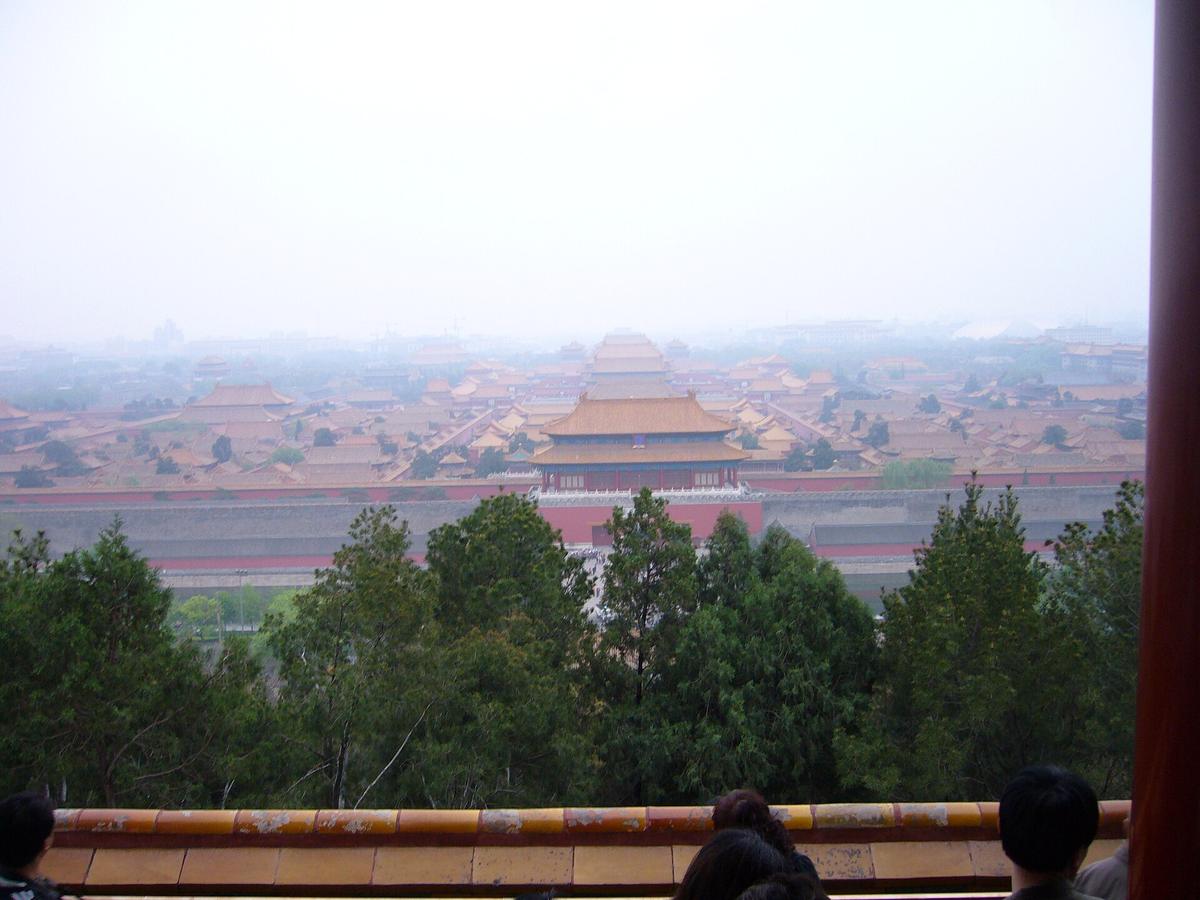
Two yuan. About 25 American cents. That is what a Beijing resident pays for a single metro stop, and it buys the only elevated view that makes sense of the hour you just spent walking the Forbidden City. You exit Shenwumen, the north gate of the palace, look up, and a tree-covered hill rises directly across Jingshan Front Street. That hill is Jingshan Park. The climb from its south gate to Wanchun Pavilion takes ten to fifteen minutes of steep stone steps. No lift. No cable car. No way to skip the effort. The reward: the entire Forbidden City laid out along its north-south axis, a view no photograph can prepare you for because no photograph captures the scale of walking it.
- Entrance Fee: CNY 2 (full price). A concession rate of approximately CNY 1 exists for qualifying visitors, though the exact discount amount is set by the Beijing Municipal Administration Center of Parks on an annual basis. No advance booking required. Pay at the gate.
- Climb Time: 10 to 15 minutes from the south gate to Wanchun Pavilion at the summit. Path surface is steep stone steps. No lift or escalator.
- Summit Elevation: 45.7 metres above central Beijing ground level, according to official park surveys. The Beijing Municipal Administration Center of Parks publishes the verified figure.
- Opening Hours: High season (April to October): 06:00 to 21:00, with last entry and last ticket sale at 20:30. Low season (November to March): 06:30 to 20:00, with last entry at 19:30. Hours are set annually by the Beijing Municipal Administration Center of Parks and change each year.
- Best Time to Visit: Late afternoon on a day after wind or rain. The light turns the palace roof tiles gold. Smog visibility is clearest in the first hours after a weather front moves through.
- Metro Access: South gate: Line 8, Shichahai station, exit C, approximately 400 metre walk. East gate: Line 6, Nanluoguxiang station, approximately 700 metre walk.
Why This View Matters More Than Any Other in Beijing
The Forbidden City is designed to be experienced from within, which is also its weakness. You walk hall after hall, courtyard after courtyard, and you never see the shape of the thing. The buildings are too big, the walls too high, the sequence too long. You emerge at Shenwumen with a sore neck and a vague sense that it was enormous, but not why that enormity mattered.
Jingshan answers that. From Wanchun Pavilion, 45.7 metres up, you see the palace's north-south axis as a single straight line. The golden roofs recede toward Tiananmen in perfect symmetry. You understand, in one glance, that the Forbidden City is not a collection of buildings but a single machine built around a single idea: the emperor at the centre of the universe, everything aligned to him. No ground-level photograph, no drone shot, and no other elevated point in Beijing shows this. The Drum Tower and Bell Tower are visible to the north. To the west, the White Dagoba of Beihai Park pierces the skyline.
Jingshan is not optional. It is the ritual that completes the Forbidden City. Skip it and you visited half a site.
How to Do it Without Wasting Time
Exit the Forbidden City through Shenwumen. That is your only choice anyway; the palace is one-way and you walk north. Cross Jingshan Front Street. The south gate of Jingshan Park is directly opposite. Pay your 2 yuan at the window. Walk straight toward the hill.
Which Gate to Use
Use the south gate. It puts you at the base of the main climb. The east gate works if you arrive via Nanluoguxiang metro station, but adds a 700 metre walk along the park wall and enters you at the side of the hill, not the foot of the axial path. The west gate makes sense only if you are coming from Beihai Park, roughly 200 metres away across Wenjin Street. For the post-Forbidden City visitor, south gate every time.
When to Arrive
Arrive late afternoon, between 16:00 and 17:00 in high season. The sun drops behind you and lights the golden roof tiles from the south. The crowds thin because most tour groups have already rushed back to their buses. You get the light, the space, and the temperature drop. Midday produces harsh shadows and flat glare. Mornings are fine but the palace roofs face south, so the light comes from behind them and they read as silhouettes.
What the Summit Gives You
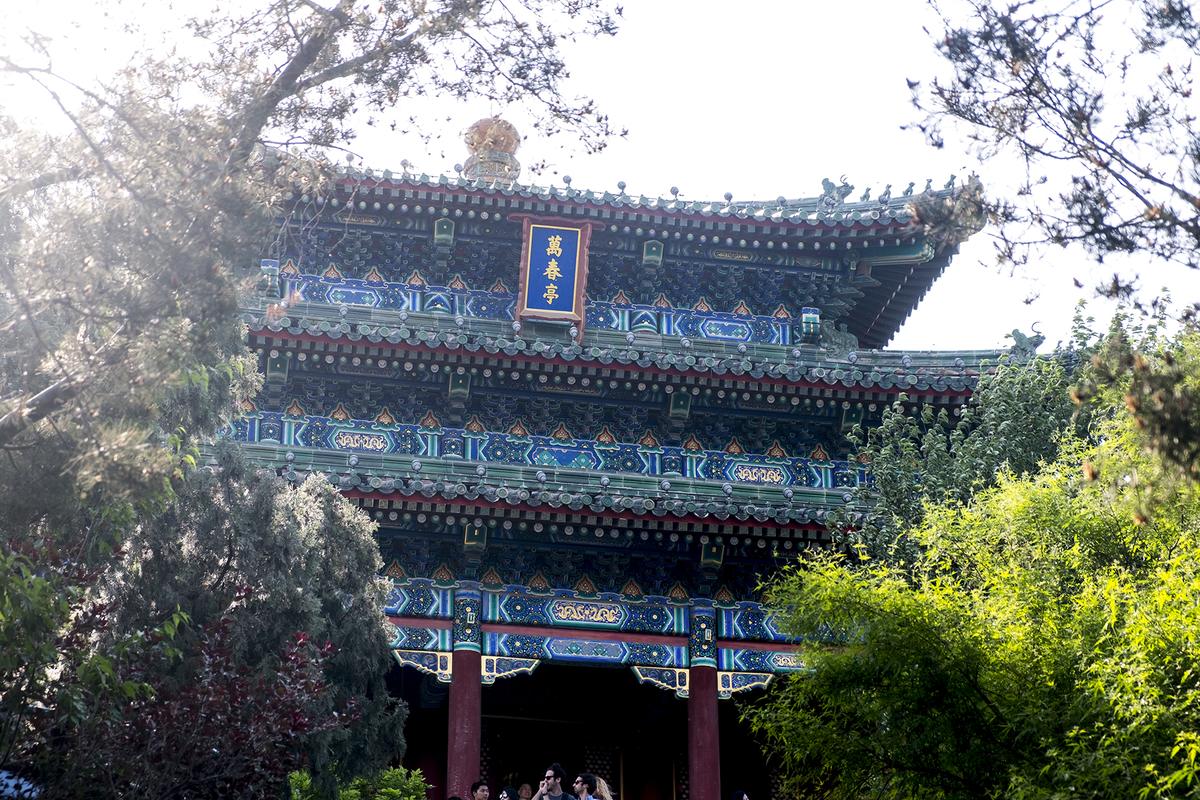
Five pavilions line the ridge. The central one, Wanchuan Pavilion, sits at the highest point. The view south is the point, but the other directions matter too. North: the Drum Tower and Bell Tower, markers of the old city's timekeeping axis. West: Beihai Park's white dagoba. East: modern Beijing rising behind the hutong roofs. The full sweep takes about 30 seconds to absorb. Stay for ten minutes minimum. The colour changes as the light shifts.
What Most Visitors Get Wrong
They rush the hill. They take the photo, check the phone, and descend inside 15 minutes. They miss the morning activities. Between 07:00 and 09:00, the park fills with residents doing tai chi, singing opera, dancing in formation. This is Beijing as it lives, not as it presents to tourists, and Jingshan is one of the best places to see it because the 2 yuan ticket keeps out nobody.
They also ignore the east slope of Jingshan. That is where you find the replacement tree marking where the Chongzhen emperor hanged himself on 25 April 1644, as the Ming dynasty collapsed. The original tree was removed during the Cultural Revolution. The current one is a replant. It is a small site: a plaque, a rope of thought. Most visitors walk right past it. Do not linger long. It is not the reason you climbed the hill. But know it is there.
Check the Air Before You Go
Visiting on a smoggy day without checking the air quality index first ruins the view. If the AQI is above 150, the palace roofs vanish into brown haze. Wait for a day after wind or rain. The first clear hours after a cold front are your window.

How to Extend the Afternoon Into Evening
Jingshan stays open until 21:00 in high season, 20:00 in low. The last entry is 30 minutes before close. Do not arrive at last entry. The climb is short, but the light goes fast at the end of day.
After you descend, you have options north and west. The hutongs around Di'anmen Inner Street, Qianliang Hutong, and Baochao Hutong are a ten minute walk north of the park. They are residential, not commercialised like the ones near Nanluoguxiang. Walk them before the restaurants close. Not to eat, just to see Beijing that does not need your money.
Beihai Park's south gate is a 200 metre walk from Jingshan's west gate across Wenjin Street. If you have energy, cross over. Beihai is larger, lake-centred, and open until 21:00 in high season. The White Dagoba catches the last light well from Beihai's east shore. Do not try to do both parks in one visit unless you started by 14:00. One good hour at Jingshan beats two rushed hours across both.
If You Have a Camera
The summit gets crowded for sunset. Claim a spot at Wanchun Pavilion 20 minutes before the actual sunset time. Do not use a tripod. The stone platform is narrow and you will block other people. Use a high ISO and brace against the railing. The shot that works is not a wide panorama. It is a tight crop on a single section of roof tile with the city behind it. That is the image that says you saw the Forbidden City whole.
Common Questions
Do I need to book Jingshan Park tickets in advance?
No. Jingshan Park does not require advance booking. Walk to any gate, pay 2 yuan (or the concession rate if applicable), and enter. No timed entry slot. No online reservation. No passport check at the gate, though carry your passport anyway for the Forbidden City exit and any nearby checks.
Can I visit Jingshan Park and the Forbidden City in the same day?
Yes, and you should. The standard approach: book the Forbidden City for a morning slot, walk it for three to four hours, exit through Shenwumen, cross the street, climb Jingshan, and watch the afternoon light hit the roofs you just walked. This is the single best half-day itinerary in Beijing.
Is the climb suitable for someone with mobility issues?
No. The path from the south gate to Wanchun Pavilion is steep stone steps with no lift or escalator. There is no accessible route to the summit. A seated view of the Forbidden City is available from the base of the hill near the south gate, but it is not the same. Skip Jingshan if you cannot manage stairs.
When do the peonies bloom in Jingshan Park?
Mid-April to late May, with peak bloom in late April to early May. The peony garden is on the east slope near the Chongzhen tree. It is popular with local photographers and families. If your visit falls outside that window, the peonies are not a reason to visit. The view is the reason.
What is the most common mistake tourists make at Jingshan?
Visiting at midday on a smoggy day and leaving after five minutes. The light is flat, the roofs are grey, and the view disappoints. Then they write online that the park is overrated. It is not overrated. They visited at the wrong time. Check the air quality index, pick a late afternoon after wind, and stay until the light shifts.
Read next
-
 Beijing Hotels by Price Band and Property Type
Beijing hotels split into hutong courtyards, international chains and functional business towers. Here is what each price band actually buys you.
Beijing Hotels by Price Band and Property Type
Beijing hotels split into hutong courtyards, international chains and functional business towers. Here is what each price band actually buys you.
-
 Where to Stay in Beijing by District and Travel Style
Dongcheng puts you beside the Forbidden City, Chaoyang beside the nightlife. Here is how Beijing's districts compare for different travellers.
Where to Stay in Beijing by District and Travel Style
Dongcheng puts you beside the Forbidden City, Chaoyang beside the nightlife. Here is how Beijing's districts compare for different travellers.
-
 Beijing Flights PEK vs PKX Which Airport Actually Works for You
PEK or PKX? What each Beijing airport costs you in time, money, and logistical friction depending on where you are staying.
Beijing Flights PEK vs PKX Which Airport Actually Works for You
PEK or PKX? What each Beijing airport costs you in time, money, and logistical friction depending on where you are staying.
-
 Beijing Things to Do Worth Your Limited Days
The Forbidden City and Great Wall are essential, but Beijing's meaning lives in temple courtyards, hutong lanes and food streets. Here is what earns your days.
Beijing Things to Do Worth Your Limited Days
The Forbidden City and Great Wall are essential, but Beijing's meaning lives in temple courtyards, hutong lanes and food streets. Here is what earns your days.
-
 Best Time to Visit Beijing, Month by Month Tradeoffs
April and October bring blue skies and queues, July brings heat, January brings empty sites and hazardous air. Here is Beijing month by month.
Best Time to Visit Beijing, Month by Month Tradeoffs
April and October bring blue skies and queues, July brings heat, January brings empty sites and hazardous air. Here is Beijing month by month.
-
 Getting Around Beijing Without Losing Half Your Day
Beijing's metro is clean and cheap but stops early, and taxis rarely speak English. Here is how to move around without burning half your day.
Getting Around Beijing Without Losing Half Your Day
Beijing's metro is clean and cheap but stops early, and taxis rarely speak English. Here is how to move around without burning half your day.
-
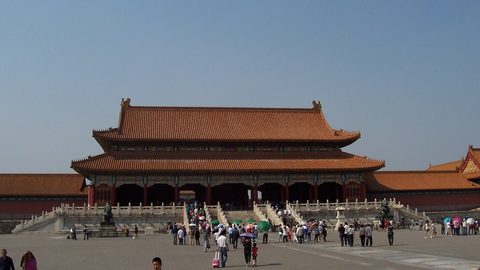 Forbidden City
 tickets require booking seven days ahead on WeChat with a passport. Here is the route to take once you are inside to avoid wasting the visit.
Forbidden City
Forbidden City tickets require booking seven days ahead on WeChat with a passport. Here is the route to take once you are inside to avoid wasting the visit.
-
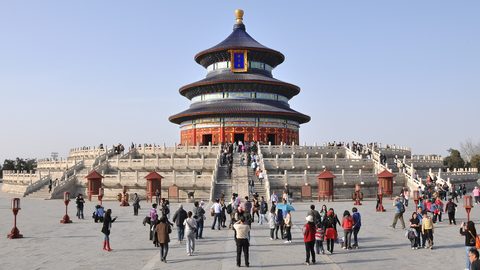 Temple of Heaven
The Temple of Heaven park matters as much as the temple. Morning tai chi, choirs, and card players make it a Beijing ritual worth a full morning.
Temple of Heaven
The Temple of Heaven park matters as much as the temple. Morning tai chi, choirs, and card players make it a Beijing ritual worth a full morning.
-
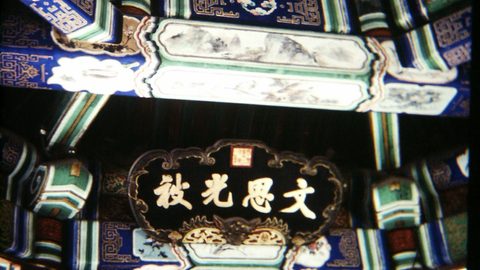 Summer Palace
The Summer Palace is vast and the wrong entrance adds an hour of walking. Use the East Palace Gate and plan for at least four hours.
Summer Palace
The Summer Palace is vast and the wrong entrance adds an hour of walking. Use the East Palace Gate and plan for at least four hours.