Eating Your Way Through Tsukiji Outer Market in One Morning
The Tsukiji outer market still packs more edible joy into a few alleyways than anywhere else in Tokyo. Here is what to eat and where to find it.
Eating Your Way Through Tsukiji Outer Market in One Morning
A woman in a white apron presses a square of hot egg into a perfect rectangle with a wooden mould, slides it onto a stick, and hands it to you across the counter. That tamagoyaki ended your search for something to eat while you stood there deciding. The tuna auction is gone. The wholesale market moved to Toyosu on October 6 2018. The outer market, called Jōgai Shijō, stayed exactly where it was. It still has roughly 400 stalls and restaurants, and they still open from 05:00 to 14:00. Sundays, national holidays, and some irregular Wednesdays shut everything down. Check the monthly calendar on the Tsukiji Outer Market official website before you go. A Wednesday you planned on might be half dead.
Where to Enter and What to Skip
Walk in from Tsukiji Station on the Tokyo Metro Hibiya Line, Exit 1, or from Tsukijishijo Station on the Toei Oedo Line, Exit A1. Both put you on the eastern edge of the market grid. The main artery is Namiki-dori, also signed as Tsukiji Namiyoke-dori. The perpendicular lane is Tsukiji Uogashi Yokocho. The inner parallel lane is Namiyoke Yokocho. Harumi-dori bounds the east, Shin-ohashi-dori the west. Spend your money on the inner lanes, not on Namiki-dori. Pre packed sushi boxes on that main street cost 20 to 40 percent more than identical boxes two rows in. The skewered scallop with uni topping that runs ¥800 to ¥1,200 on Namiki-dori sells for less on Namiyoke Yokocho. The wagyu skewer stalls charging ¥1,500 to ¥2,500 per stick and the whole grilled crab legs at ¥3,000 to ¥5,000 are the biggest traps. Skip them. Head for the stalls where Japanese shoppers queue.
Cash and ATMs
Most stalls are cash only. Some knife shops take cards. The ATMs you can trust are the 7-Eleven ATMs on Harumi-dori and the Japan Post ATM inside Tsukiji Post Office. Get your cash before you enter the narrow lanes. You will not find a machine inside the market.
.jpg)
Start with Tamagoyaki, Standing Up
Buy the egg first. It is cheap, fast, and tells you which way the grill smoke is blowing. Tsukiji Yamachō at 4 10 10 Tsukiji has been doing this since 1950. Their signature is atsuyaki tamago, a thick rolled omelette served on a stick. The 2024 price was ¥120 to ¥150 per stick, published by the stall itself and revised periodically. Open 06:00 to 15:00, closed Sundays and holidays. Marutake, a few stalls away, sells a similar stick for ¥100 to ¥130 in 2024. Same hours, same closure pattern. Eat it standing, leaning against the counter, still hot. That is the point. Cold tamagoyaki is a different thing.
The next standing stop is uni. Unitora, listed as Tsukiji Itadori Uogashi at 4 10 14 Tsukiji, serves fresh uni gunkan maki. The 2024 price per piece ranged from ¥500 to ¥1,500 depending on the uni grade and season. The stall opens at 07:00 and closes at 14:00 or earlier if it sells out. It sells out most days by 11:00. Eat that standing too. Do not ask for a table. There is none.
The Sushi Breakfast Decision: Three Options, Very Different Queues
The reason most people come here at dawn is a seated sushi breakfast. You have three choices. Two are famous enough to ruin your morning. One is a sensible 24 hour backup. Pick based on how long you will wait.
Sushi Dai and Sushi Daiwa: The Legacy Queue
Sushi Dai at 6 21 2 Tsukiji, inside the Tsukiji Fish Center building, opens at 05:30. Start lining up at 03:30 to 04:00. At 05:00 the wait is 60 to 90 minutes. At 07:00 it jumps to 120 to 180 minutes. By 09:00 the staff cuts off the line for the day. The omakase in 2024 was ¥4,500 to ¥5,500 for 10 to 12 pieces of chef s choice nigiri plus a roll. Sushi Daiwa sits adjacent at the same address. It also opens at 05:30. The queue at 06:00 is 30 to 60 minutes. At 08:00 it is 60 to 120 minutes. The 2024 omakase was ¥4,000 to ¥5,000. You sit at a counter with eight or nine other people. The chef places each piece in front of you one at a time. The pacing is fast. You eat and leave. That is the experience. If you arrive after 08:00 at Sushi Dai, walk to Sushi Daiwa instead. If both are over 90 minutes, walk away.
Sushizanmai Tsukiji Ekimae: The 24 Hour Backup
Sushizanmai Tsukiji Ekimae at 4 11 9 Tsukiji, the main branch of the chain, is open 24 hours. The queue for the Tsukiji Breakfast Set starts forming around 05:30 to 06:00. At 06:00 the wait is 15 to 30 minutes. At 08:00 it is 45 to 90 minutes. At 10:00 it hits 60 to 120 minutes. The 2024 set price was ¥2,500 to ¥3,500 for 8 to 10 pieces of nigiri, miso soup, and tamagoyaki. The rice is slightly warmer and the fish is slightly less polished than the omakase counters. It is still good sushi. It is a fraction of the wait. If your flight lands at 02:00 and you want to eat at 03:00, this is where you go. If you have a family with small children, go here. The wait is shorter and you can get a table rather than a counter.
Saturday and the day before a national holiday are the worst days for all three. The market is fully closed on Sundays and national holidays, so Saturday crowds are punishing. Arrive by 05:00 on those days or skip sushi entirely and eat standing.
What Else to Eat Between Stalls
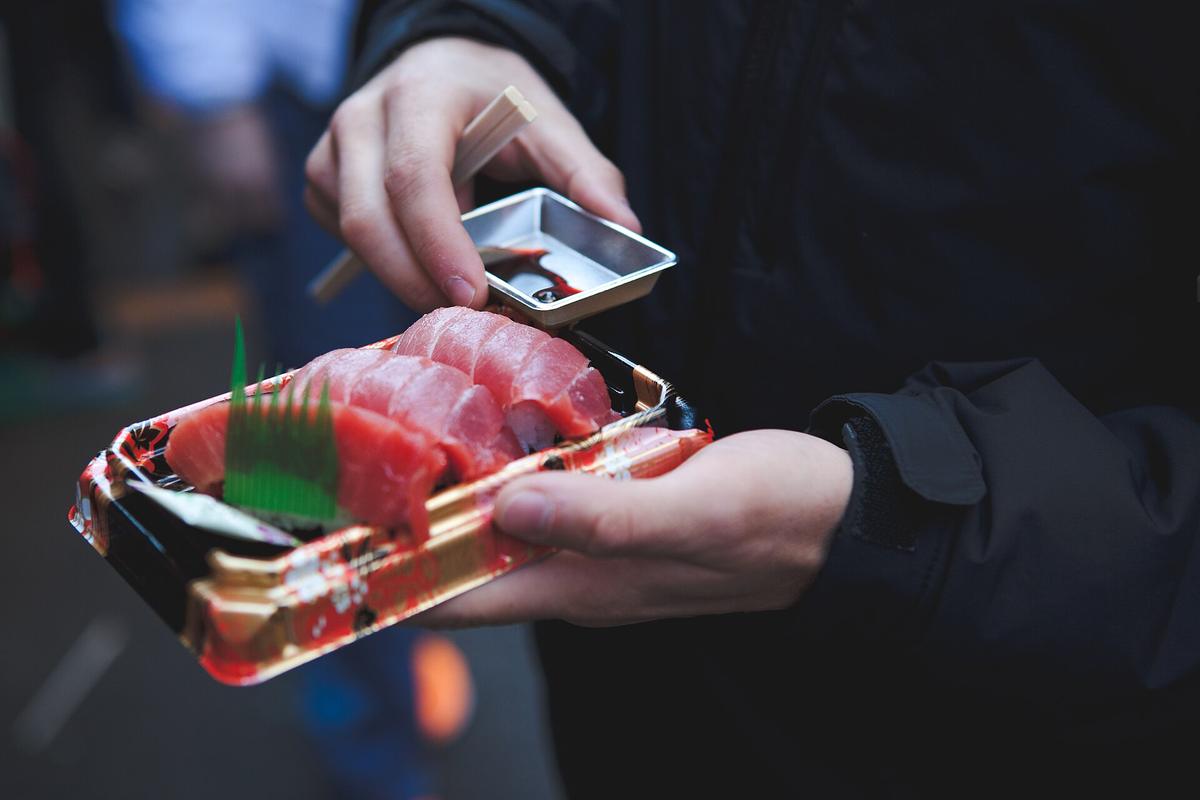
Beyond egg and uni, buy from stalls selling single ingredient things cooked in front of you. Grilled eel skewers. Scallops in their shells with butter and soy sauce. Sea urchin that came off a boat that morning. The difference between a good stall and a bad one is the queue of Japanese office workers. If the people in front of you are holding shopping bags from the inner lanes and pointing at the same thing, buy it. If every person has a phone camera and a selfie stick, walk past.
Knife Shops Worth the Detour
Two knife shops sit south of the main food lanes. Tsukiji Masamoto at 4 9 9 Tsukiji opens 06:00 to 14:00 Monday to Saturday. A santoku knife in 2024 ran ¥8,000 to ¥25,000. They engrave your name in kanji or katakana and give you sharpening advice. Aritsugu Tsukiji at 4 13 6 Tsukiji opens 07:00 to 14:00 Monday to Saturday. Both close on Sundays, holidays, and market closure days. If you buy a knife, pay cash. Some of these shops do accept cards, but not all. Bring enough yen if you plan to buy a blade.

The Toyosu Option: If You Insist on the Auction
If seeing a frozen tuna auction is non negotiable, go to Toyosu Market at 6 6 1 Toyosu in Koto ward. The observation deck is free and open 05:00 to 06:30. The peak viewing window is 05:30 to 06:00. The lower level lottery is suspended, so the upper deck is your only view. From Tsukiji, take the Yurikamome line from Shimbashi to Shijō mae Station, about 20 minutes, or the Tokyo BRT from Shimbashi to Toyosu, about 25 minutes. Toyosu closes on the same Sundays, national holidays, and irregular Wednesdays. After the auction, come back to Tsukiji for breakfast. That is the correct move. Do not eat at Toyosu. The restaurant area called Uogashi Yokocho is fine but the Tsukiji outer market has more variety and better prices.
Frequently Asked Questions
Does the Tsukiji Outer Market still have the tuna auction?
No. The wholesale market including the tuna auction moved to Toyosu on October 6 2018. The outer market has food stalls and restaurants only.
What is the market called officially?
It is called Jōgai Shijō, or Tsukiji Outer Market. It is operated by the Tsukiji Jōgai Shijō Shopping Street Promotion Association.
What days is the market completely closed?
Sundays, national holidays, and some Wednesdays. The Wednesday closures are irregular. Check the monthly calendar on the official Tsukiji Outer Market website before you go.
What are the opening hours for stalls and restaurants?
Most stalls open 05:00 to 14:00. Most restaurants open 06:00 to 14:00. Sushizanmai Tsukiji Ekimae is the exception, open 24 hours.
Is it true that most stalls only take cash?
Yes. The majority of stalls are cash only. Some knife shops accept cards. Use the 7-Eleven ATMs on Harumi-dori or the Japan Post ATM inside Tsukiji Post Office before you enter the market.
How long is the queue for Sushi Dai vs Sushi Daiwa vs Sushizanmai?
Sushi Dai at 07:00 is 120 to 180 minutes. Sushi Daiwa at 08:00 is 60 to 120 minutes. Sushizanmai at 08:00 is 45 to 90 minutes. Sushizanmai is the only one open 24 hours.
Where can I buy a Japanese chef s knife?
Tsukiji Masamoto at 4 9 9 Tsukiji and Aritsugu Tsukiji at 4 13 6 Tsukiji. Both open Monday to Saturday, closed Sundays and holidays. Bring cash for a santoku knife in the ¥8,000 to ¥25,000 range in 2024 pricing.
Read next
-
 Tsukiji Beyond Sushi Breakfast The Temple the Walk and Ginza Next Door
Once you have eaten your fill at Tsukiji, a quiet temple quarter and a straight road to Ginza are waiting. Here is how to spend the rest of the morning.
Tsukiji Beyond Sushi Breakfast The Temple the Walk and Ginza Next Door
Once you have eaten your fill at Tsukiji, a quiet temple quarter and a straight road to Ginza are waiting. Here is how to spend the rest of the morning.
-
 Japan Travel Guide for First-Timers Who Like Order but Not Crowds
Japan delivers deep tradition and futuristic efficiency, but the language barrier and density of rules can exhaust first-timers. Here is what to actually expect.
Japan Travel Guide for First-Timers Who Like Order but Not Crowds
Japan delivers deep tradition and futuristic efficiency, but the language barrier and density of rules can exhaust first-timers. Here is what to actually expect.
-
 Japan eSIM vs Pocket WiFi vs Physical SIM for Staying Connected
Free public WiFi across Japan is unreliable and slow. Compare eSIM plans from Ubigi and Airalo against renting a pocket WiFi device at Narita or Haneda.
Japan eSIM vs Pocket WiFi vs Physical SIM for Staying Connected
Free public WiFi across Japan is unreliable and slow. Compare eSIM plans from Ubigi and Airalo against renting a pocket WiFi device at Narita or Haneda.
-
 Japan Visa-Free Entry and the Visit Japan Web Digital Form
Visa-free entry covers many nationalities, but the Visit Japan Web digital form and QR codes determine how quickly you clear immigration at Narita or Haneda.
Japan Visa-Free Entry and the Visit Japan Web Digital Form
Visa-free entry covers many nationalities, but the Visit Japan Web digital form and QR codes determine how quickly you clear immigration at Narita or Haneda.
-
 Cash and IC Cards Are the Real Payment System in Japan
Japan projects a high-tech image but many small restaurants, temples, and rural buses demand cash. IC cards like Suica and Icoca bridge the gap for daily spending.
Cash and IC Cards Are the Real Payment System in Japan
Japan projects a high-tech image but many small restaurants, temples, and rural buses demand cash. IC cards like Suica and Icoca bridge the gap for daily spending.
-
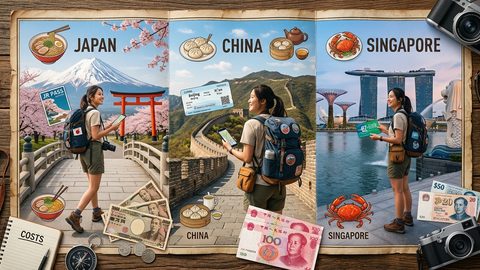 What Japan, China, and Singapore Actually Cost Independent Travelers
Real per-day costs for Japan, China, and Singapore broken down by accommodation tier, food strategy, transit, and connectivity for independent travelers.
What Japan, China, and Singapore Actually Cost Independent Travelers
Real per-day costs for Japan, China, and Singapore broken down by accommodation tier, food strategy, transit, and connectivity for independent travelers.
-
 What Most Travelers Get Wrong When Booking Flights to East Asia
Most travelers book East Asia flights on price alone. Here's what they miss about route gaps, fleet age, and aircraft type on 10-14 hour hauls.
What Most Travelers Get Wrong When Booking Flights to East Asia
Most travelers book East Asia flights on price alone. Here's what they miss about route gaps, fleet age, and aircraft type on 10-14 hour hauls.
-
 The Honest Cost of Mobile Data in Japan, China, and Singapore
Real price data for SIMs, pocket WiFi, and eSIMs in Japan, China, and Singapore. Plus the friction points most travel guides quietly skip.
The Honest Cost of Mobile Data in Japan, China, and Singapore
Real price data for SIMs, pocket WiFi, and eSIMs in Japan, China, and Singapore. Plus the friction points most travel guides quietly skip.
-
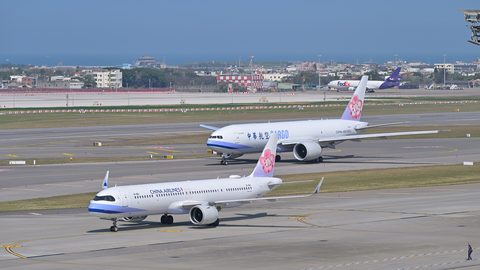 Fifth Freedom Flights Are the Award Sweet Spot Nobody Searches For
Fifth-freedom flights let you fly a foreign airline between two other countries, and they often have award seats when the airline's own hub routes are sold out.
Fifth Freedom Flights Are the Award Sweet Spot Nobody Searches For
Fifth-freedom flights let you fly a foreign airline between two other countries, and they often have award seats when the airline's own hub routes are sold out.