Khao Takiab the Giant Buddha Headland Temple With a View Down the Whole Beach
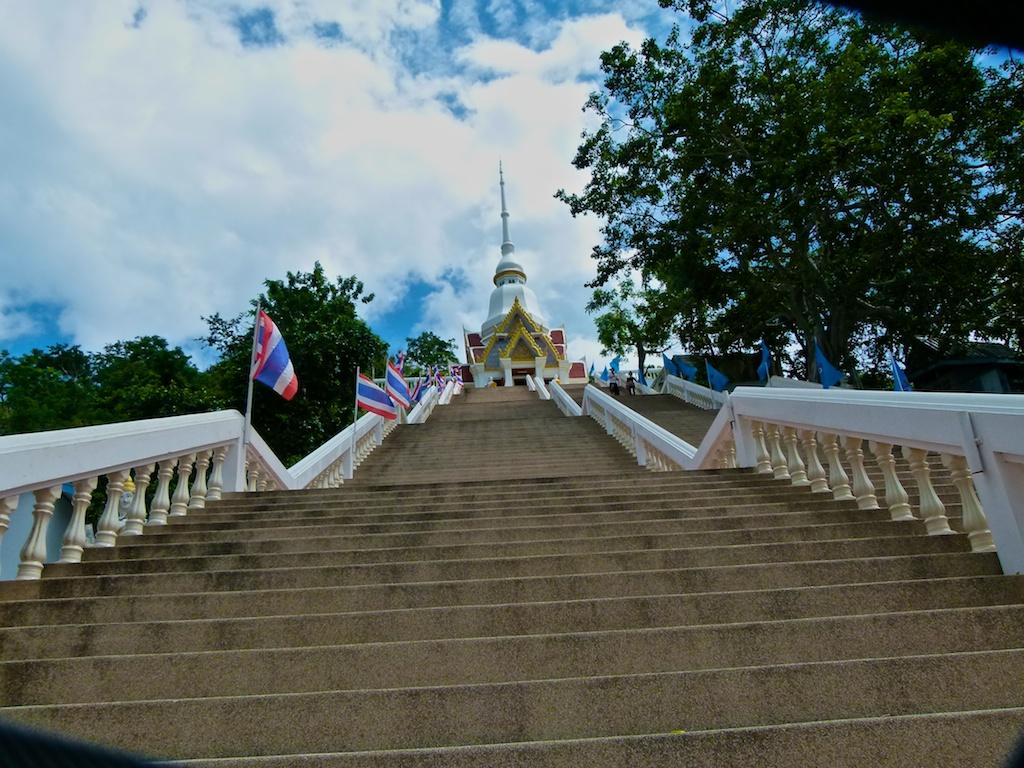

The question everyone asks before climbing Khao Takiab is whether the monkeys are as bad as the stories say. They are worse. The macaque troop at the base of Chopstick Mountain has graduated from opportunistic snatching to targeted theft, and no one on site is doing anything to stop it. A bag. A pair of sunglasses. A phone held at the wrong angle. All are gone in the same half second it takes a monkey to drop from a railing, grab, and retreat out of reach. The temple, the giant Buddha statue on the summit, and the view down the entire 5km sweep of Hua Hin beach are worth the climb. But Khao Takiab demands a specific kind of preparation that most first-time visitors do not bring.
- Name: Khao Takiab
- Also Called: Chopstick Hill
- What It Is: Headland at the southern end of Hua Hin beach with a working Buddhist temple on the summit
- Summit Feature: Large standing Buddha statue facing the sea
- Climb Option 1: Paved road
- Climb Option 2: Staircase
- Climb Duration: Approximately 15 minutes
- Entry Fee: Free
- Temple Dress Code: Shoulders and knees must be covered
- Best Time: Late afternoon
- Recommended Duration: Approximately 1 hour
- Monkey Risk Level: High; known to snatch bags, sunglasses, food, phones, and will bite
What Khao Takiab Temple Actually Looks Like
The Climb to the Summit
Khao Takiab temple is a working Buddhist site crammed onto a steep headland at the southern tip of Hua Hin beach. You approach it through the village at the base, a strip of seafood restaurants and souvenir stalls that caters mostly to Thai families and the residents who live in the condo towers rising behind the headland. The climb takes roughly 15 minutes. You have two routes: a paved road that curves up the gentler slope, or the steps that go straight up through the trees. Take the steps up. It is hotter, steeper, and you will stop to catch your breath at least once, but the steps put you directly in front of the minor shrines and incense stations along the way. Those are where you see how the temple operates as a living site rather than a tourist viewpoint.
The Summit Buddha and the View
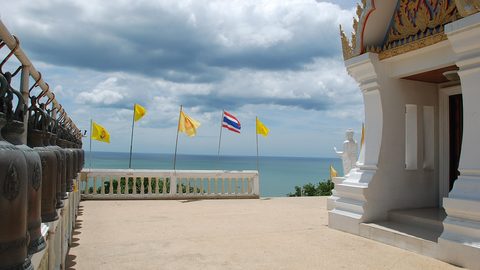
The summit is dominated by the giant Buddha statue, a large standing figure facing the sea with one hand raised in a blessing gesture. The statue is not ancient: it was built in the modern era and shows it, painted white and gold, surrounded by donation boxes and smaller Buddha images. What makes it worth the climb is the panoramic view. From the summit platform you can see north along the entire Hua Hin beach strip, past the rows of hotel umbrellas and the fishing boats pulled up on the sand, all the way to the headland of Khao Takiab's twin hill in the distance. Arrive in the late afternoon. The light softens, the heat drops, and the sea turns a colour that almost tricks you into forgetting it is murky.
Khao Takiab Monkeys: the Threat is Specific
You have heard the generic warnings about not feeding monkeys. The Khao Takiab macaques are past that. They are habituated to humans to the point where they do not fear them, and they have learned exactly which objects are worth stealing. Bags with straps are the most common target because a strap can be grabbed mid-swing. Sunglasses are next: monkeys wait until a visitor looks away, then dart in to pull glasses off a face. Phones held in the hand while taking photos are at extreme risk, particularly on the lower half of the steps where the monkeys sit on the railings and watch every visitor pass.
There are no deterrents in place. No monkey guards. No warning signs that prepare you for the actual level of aggression. No barriers separating the troop from the walkway. The only thing you will see locals using are sticks. Carrying a stick is not decoration: it is a deterrent. If a monkey approaches, the local taps the stick on the ground or lifts it. The monkey backs off. Do not skip this. Pick up a fallen branch at the village base before you start climbing, or buy one of the thin bamboo rods sold by a vendor near the temple entrance. You will look like a tourist either way. You will also keep your belongings.
If a monkey bites, the consequence is a rabies assessment at a medical facility. Hua Hin has several clinics and a hospital, but the assessment takes time and the rabies post-exposure shots are a series. Do not make eye contact with the monkeys. Do not eat or drink anything on the steps or the summit platform. Do not carry a plastic bag: the macaques associate plastic bags with food and will target them. Secure everything in a zipped bag worn across your body, not on one shoulder. If you wear sunglasses, put them in the bag before you reach the monkey zone, not when a monkey is already looking at you.
Chopstick Mountain Hua Hin: Why it Has That Name
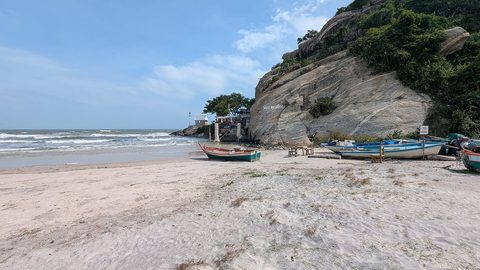
The headland is called Khao Takiab in Thai, which translates roughly to Chopstick Mountain. Two explanations circulate locally: one says the shape of the paired headlands and the narrow beach between them resembles chopsticks resting on a holder; another says the name comes from the crab traps once set here. Either way, the name Chopstick Mountain has stuck among English-speaking visitors, and you will hear it used interchangeably on tours and in taxi conversations. The headland is not just the temple. The rock formations at the base, the shallow tide pools visible at low tide, and the fishing boats moored off the beach are part of the same landscape. Hua Hin residents come here for the seafood shacks set directly on the rocks, where you eat grilled squid and blue crab on plastic chairs with waves splashing your feet.
Khao Takiab Beach: Where the Headland Meets the Sand
Khao Takiab beach is the continuation of Hua Hin's main beach, running north from the headland. At low tide you can walk south from the central Hua Hin hotels all the way to the base of the mountain on the sand. At high tide the beach narrows considerably, and in some sections the water reaches the seawall, leaving no room for a chair. The water here is the same as the rest of Hua Hin: murky, prone to jellyfish swarms from July to October, and marked with vinegar stations where box jellyfish have been reported. The beach is not the reason to come to Khao Takiab. The reason is the headland, the temple, the seafood, and the view.
The fishing boats moored off the beach are photogenic in the late afternoon light. The village at the base, with its seafood restaurants and small guesthouses, is the most relaxed part of Hua Hin's southern end. If you are staying in the condo towers on Soi 102, Khao Takiab beach is your closest access point to the sea. If you are staying in central Hua Hin, get here by songthaew or taxi. The walk from the night market area takes over an hour on sand that is not always firm enough for easy walking.
| Do | Do Not |
|---|---|
| Secure all belongings in a zipped bag worn across your body | Carry a plastic bag or anything that looks like food packaging |
| Pick up a stick or bamboo rod before climbing | Make eye contact or smile showing teeth |
| Visit in the late afternoon when the troop is less active | Eat or drink on the staircase or summit |
| Remove sunglasses before entering the monkey zone | Hold a phone in your hand while walking |
| Keep children close and do not let them approach the macaques | Assume the problem is exaggerated |
.jpg)
Getting to Khao Takiab by Songthaew
By Songthaew
Getting there without a car is straightforward if you use the songthaew route. Songthaews in Hua Hin run fixed routes along the main roads for 10 to 20 THB per ride. Flag one down from any point on the main beach road heading south. The driver will know Khao Takiab. The ride from the night market area to the headland takes roughly 15 minutes depending on traffic. The dominant friction in Hua Hin's transport system is that Grab and Bolt are legally restricted by the local taxi mafia, so pick-ups happen away from major hotel entrances, leaving you with overpriced hotel taxis as the only alternative. If you are staying in a large hotel, walk to the main road and flag a songthaew from there. Say "Khao Takiab" or show the driver the name written down. The drop-off point is at the base of the headland, right where the seafood restaurants begin and the monkey zone starts.
By Taxi or Private Car
A private taxi from central Hua Hin to Khao Takiab costs roughly 150 to 300 THB if negotiated before departure. The hotel front desk will quote double that. Walk out to the street and negotiate with a taxi waiting at the songthaew stop instead. The drive takes under ten minutes.
On Foot Along the Beach
At low tide, you can walk from the southern end of Hua Hin beach to Khao Takiab on the sand. The walk takes 40 minutes to an hour from the Hilton area. Check the tide table before you set out: if the tide is rising, you will be forced onto the soft sand at the top of the beach or onto the road. Do not attempt this in the midday heat.
Seafood on the Rocks: Eating at the Base
The village at the base of Khao Takiab is lined with seafood restaurants, but one stands above the rest. Kao Takiab Seafood on the Rocks is the restaurant that Hua Hin residents use when they want grilled squid and blue crab eaten on plastic chairs set on the flat rocks at the water's edge. The waves splash your feet while you eat. The vinegar and salt dips come with fresh chilli. The menu is short and season-dependent: whatever the fishing boats brought in that morning. This is not a place for a refined meal. It is a place for eating with your hands, letting the crab shells pile up on the paper plate, and watching the sun drop behind the headland. Arrive before sunset if you want a table with a view. The restaurant opens from late morning until the food runs out, usually around 21:00.
Other restaurants on the strip serve similar food at similar prices. The difference is the position. The ones set directly on the rocks have the edge. If the tide is high and the waves are coming over the rocks, the higher tables at the back are still worth it. The sound and the salt spray are part of the experience.
Temple Dress Code and Practical Details
What to Wear
Khao Takiab is a working Buddhist temple. The dress code requires shoulders and knees to be covered. If you arrive in a singlet and shorts, you will be stopped at the base of the steps. Carry a thin long-sleeve shirt and a sarong in your bag. Put them on before you start climbing, and remove them at the summit after you have visited the shrine area. Shoes come off before entering the temple buildings. Leave them in the designated rack. Do not leave anything valuable in your shoes.
Timing Your Visit
The temple is free to enter. There is no ticket booth and no timed entry. The steps are open from dawn until dusk. The best time to visit is late afternoon: the light is better for photos, the temperature is lower, and the crowds thin out as the day ends. The sunrise crowd is smaller but the summit is in shadow until the sun rises high enough to clear the mountain behind you. Monkey activity at sunrise is high. The late afternoon visit still carries monkey risk, but the troop is less active in the heat of the day.
Common Questions
How bad are the monkeys at Khao Takiab?
Worse than generic warnings suggest. The macaques will grab bags, sunglasses, phones, and food directly from your hands or face. They bite. No deterrents or guards are in place. Carry a stick for protection and secure everything in a zipped bag worn across your body.
Can I walk to Khao Takiab from central Hua Hin?
Yes, at low tide, along the beach. The walk takes 40 minutes to an hour from the Hilton area. At high tide, the beach narrows and you are forced onto the road. Check the tide table before setting out.
Do I need to cover my shoulders and knees to visit the temple?
Yes. The temple enforces the dress code. Bring a cover-up in your bag or you will not be allowed past the base of the steps. Shoes must be removed before entering shrine buildings.
Is there an entry fee for Khao Takiab temple?
No. Entry is free. The only costs are donations in the boxes at the summit and optionally buying a stick from a vendor at the base for monkey deterrent.
Read next
-
 Hua Hin Hotels by Type and Price Where Midweek Rates Halve
Hua Hin hotels are shaped by Bangkok weekend demand, so midweek rates often run half the weekend price—the single most useful fact for booking a stay on this coast.
Hua Hin Hotels by Type and Price Where Midweek Rates Halve
Hua Hin hotels are shaped by Bangkok weekend demand, so midweek rates often run half the weekend price—the single most useful fact for booking a stay on this coast.
-
 Where to Stay in Hua Hin Along Fifteen Kilometres of Coast
Where to stay in Hua Hin depends on whether you want night market walkability, a condo near Soi 102 cafes, or a family resort up the coast in Cha-Am—and your transport plan follows from that choice.
Where to Stay in Hua Hin Along Fifteen Kilometres of Coast
Where to stay in Hua Hin depends on whether you want night market walkability, a condo near Soi 102 cafes, or a family resort up the coast in Cha-Am—and your transport plan follows from that choice.
-
 Hua Hin Flights Why You Fly to Bangkok and the Airport Bus Beats a Connection
-
 Hua Hin Things to Do Ranked for a Town Where Less Is the Point
Hua Hin things to do are fewer than most Thai beach towns, and that is the point—this is a place for beach horse rides, weekend markets, and seafood, not an attraction-packed itinerary.
Hua Hin Things to Do Ranked for a Town Where Less Is the Point
Hua Hin things to do are fewer than most Thai beach towns, and that is the point—this is a place for beach horse rides, weekend markets, and seafood, not an attraction-packed itinerary.
-
 Best Time to Visit Hua Hin Month by Month in a Rain Shadow Coast
The best time to visit Hua Hin is December to March for cool dry weather, but its rain shadow means the wet season is milder than Phuket's—a genuine reason to come when other coasts are poor.
Best Time to Visit Hua Hin Month by Month in a Rain Shadow Coast
The best time to visit Hua Hin is December to March for cool dry weather, but its rain shadow means the wet season is milder than Phuket's—a genuine reason to come when other coasts are poor.
-
 Getting Around Hua Hin When the Town Is Strung Out and Grab Fails
Getting around Hua Hin requires a plan: the town stretches ten kilometres, Grab is restricted by the local taxi mafia, and songthaews on fixed routes become your most reliable option.
Getting Around Hua Hin When the Town Is Strung Out and Grab Fails
Getting around Hua Hin requires a plan: the town stretches ten kilometres, Grab is restricted by the local taxi mafia, and songthaews on fixed routes become your most reliable option.
-
 Hua Hin Night Market
-
 Thailand Travel Guide From First Timers To Island Hoppers
A realistic Thailand travel guide covering regions, seasons, and pacing so you avoid the classic Bangkok Chiang Mai island mistake.
Thailand Travel Guide From First Timers To Island Hoppers
A realistic Thailand travel guide covering regions, seasons, and pacing so you avoid the classic Bangkok Chiang Mai island mistake.
-
 Thailand eSIM Costs Per Gigabyte And Which Network Covers The Islands
Compare Thailand eSIM options by cost per gigabyte and check AIS versus TrueMove coverage for the Andaman islands before you land.
Thailand eSIM Costs Per Gigabyte And Which Network Covers The Islands
Compare Thailand eSIM options by cost per gigabyte and check AIS versus TrueMove coverage for the Andaman islands before you land.