When to Visit Rikugien Garden in Tokyo for Autumn Colour and Spring Flowers
Rikugien Garden in Tokyo is worth planning a trip around its late November night maple illumination and late April weeping azalea bloom.
.jpg)
Two Windows, One Garden, Worth Planning Your Trip Around
Rikugien Garden holds its autumn evening illumination from late November to early December each year, and its spring weeping cherry illumination from mid-March to early April. Those are the only times you should time a trip around. Visit on a regular weekday outside those windows and you get a quiet, lovely Edo-period stroll garden that most Tokyo residents treat as a local secret. That is fine for an empty afternoon. But the night illuminations transform the place into something the city talks about.
- Autumn Illumination: Momiji no Yoiyami to Niwa-akari, late November to early December, 09:00 to 21:00 (last entry 20:30)
- Spring Illumination: Shidare-zakura to Haru no Niwa-akari, mid-March to early April, 09:00 to 21:00 (last entry 20:30)
- Autumn Illumination Admission: ¥1,100 adults, ¥600 seniors (65+) at 2024 rates; check Tokyo Metropolitan Park Association for current pricing
- Daytime Admission: ¥300 adults, ¥150 seniors, free for elementary school children
- Nearest Station: JR Yamanote Line or Tokyo Metro Namboku Line to Komagome Station, 2-minute walk from South Exit (JR) or Exit 2 (Metro)
- Annual Closure: December 29 to January 1
- Garden Area: 87,809.41 m²
- Designation: Special Place of Scenic Beauty (1953)
The Autumn Illumination: Late November Nightfall Over the Pond
Securing Your Entry
You enter from Komagome Station, a two minute walk to the main gate. The queue moves fast because the garden sells timed entry tickets online, and you want one of those, not a walk up gamble. Tickets go on sale one to two weeks before the event. Set a calendar reminder for three weeks out and check the Tokyo Metropolitan Park Association site daily. The event sells out for weekend slots.
Navigating the Pond Circuit
Once inside, the route is dictated by the pond. The central feature is Ōizumi, the large pond, and the path circuits it counterclockwise. Do not reverse direction. The crowd is managed in one way, and fighting it costs you the best sightlines at the maple framed islands.
Where the Light Hits Hardest
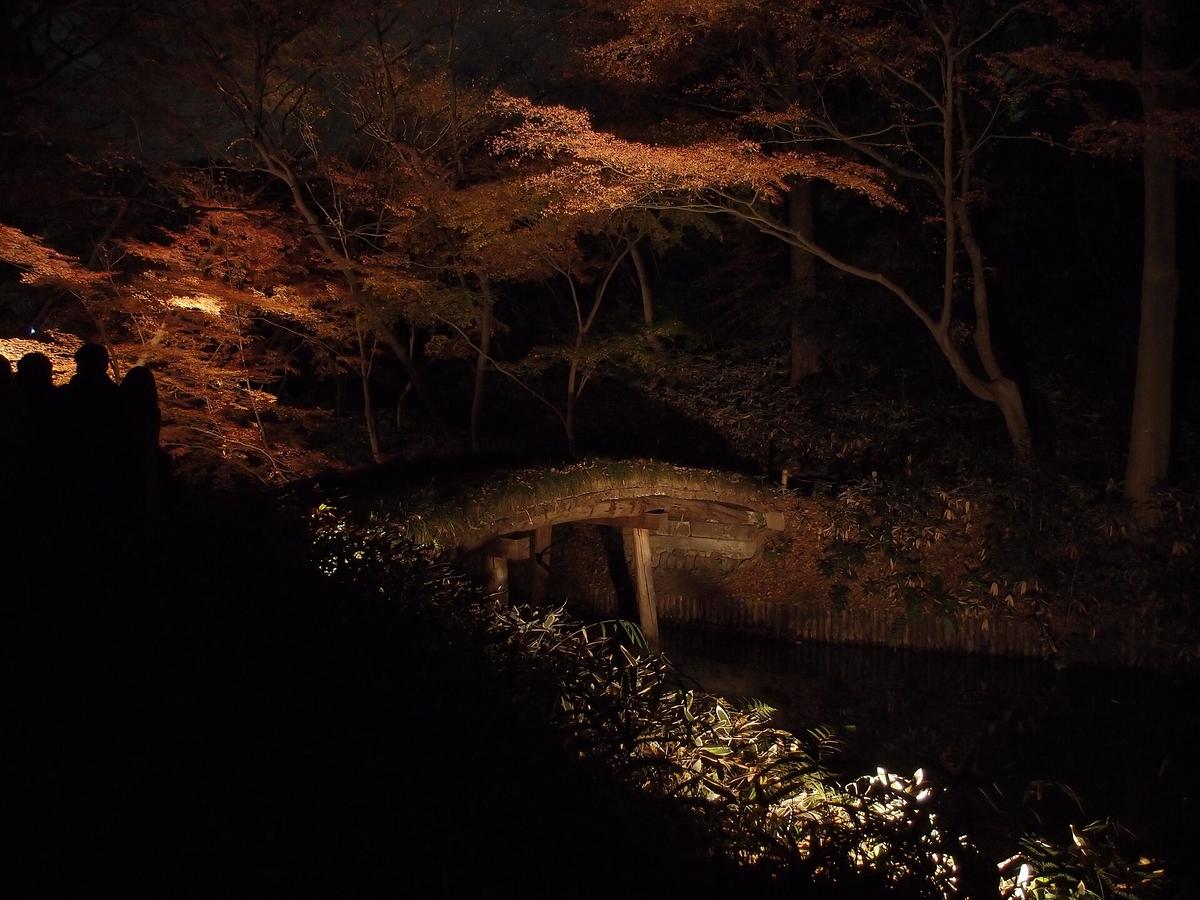
By 17:00 the light fades and the garden shifts. The illumination is understated by Japanese garden standards, which is its strength. There are no lasers or colour washes. The maples are lit from below, and the reflection in Ōizumi doubles every red and orange leaf. The 88 waka poetry scenes that the garden was built to represent become visible in a way daylight cannot deliver. You see the deliberate framing of a view from a specific stone or bridge, exactly as the Edo designer Yanagisawa Yoshiyasu intended in 1702. The effect is strongest at the southwest side of the pond, where Fukiage Chaya teahouse sits. It stays open during illumination evenings, serving matcha and wagashi for ¥700. The line is long, but the view from that corner, tea in hand, over the lit water, is the single best spot in the garden. Budget 30 minutes waiting.
The Spring Window: Weeping Cherry and a Shorter Crowd Window
The One Tree That Matters
The spring illumination runs mid-March to early April, and it exists for one tree. The Shidare-zakura weeping cherry stands approximately 15 metres tall and 20 metres wide, planted about 70 years ago. It is not old by Tokyo tree standards. But its location on a slight rise near the pond's north edge means that when lit at night, the cascading branches form a curtain of pale pink against dark water. That is the image that fills Instagram. Get there before 18:00 to claim a position on the path directly southwest of the tree, where the reflection is clearest.
Timing the Bloom
The weeping cherry blooms for a shorter window than the autumn maples. Rain or wind can cut the peak to four or five days. The illumination event runs roughly two weeks, but the tree itself may only be at full bloom for half that. Monitor the Tokyo Metropolitan Park Association's bloom updates daily in the week before your trip. If the tree peaks early, adjust your plan. Do not arrive expecting a guarantee.
Morning: The Garden Without the Crowd
Daytime visits during the spring window are calmer. The garden opens at 09:00, and the first hour is almost empty. You can walk the full circuit around Ōizumi without crowd pressure, stop at Fukiage Chaya for that matcha set at an actual table, and leave before the 11:00 rush. The timed entry system applies only to evening illumination hours, not daytime admission. Use the morning to see the garden as it was intended: a quiet strolling park with 88 poetic references hidden in the landscape, not a ticketed light show.
How the Garden Works the Rest of the Year
Outside the two illumination windows, Rikugien is a local garden. You pay ¥300, walk through the gate, and share the path with maybe 40 other people on a Tuesday morning. That is the correct experience for understanding what an Edo daimyo garden felt like. The 87,809 square metres of space, the carefully placed stones, the artificial hills built to evoke specific poems, the slow water of Ōizumi, none of that competes with crowds. If you arrive in October or May, you see the actual design.
But the garden is smaller than Hama-rikyu (which covers 250,215 square metres with a tidal pond) and comparable in size to Koishikawa Korakuen (70,847 square metres). Neither of those runs illuminations. If you want lit autumn maples in Tokyo, Rikugien is the only one of the three you can get. If you just want a walk, the other two are less crowded and have teahouses too. Go to Koishikawa Korakuen for its Chinese influenced landscape and lower crowds. Go to Hama-rikyu for the seawater pond and the view of Shiodome skyscrapers. Go to Rikugien only if you time the illumination.
The standard opening hours are 09:00 to 17:00, last entry 16:30. The garden closes December 29 through January 1. That New Year closure is absolute. Do not plan a visit during that week.
Practicalities That Matter
Getting There
The garden sits two minutes from Komagome Station on the JR Yamanote Line. The Yamanote loop means you can reach it from Shinjuku in about 15 minutes, from Tokyo Station in about 18 minutes, from Ueno in 8 minutes. That is the fastest access. The Tokyo Metro Namboku Line also stops at Komagome, same walk. Use the South Exit from JR, Exit 2 from Metro.
Ticket Strategy
Timed entry tickets for illumination evenings require a reservation. The system works but it is strict. Buy for the 17:00 to 18:00 slot. Arrive at 16:45. You enter in the last of the daylight, watch the transition, and stay through the full dark period. The 20:30 last entry means you can stay until 21:00 close. That gives you three hours of lit garden. Two hours is enough. One hour is not.
The autumn illumination carries its own admission, last published at ¥1,100 for adults and ¥600 for seniors; the garden lists the current rate and the ticketing window. The Tokyo Metropolitan Park Association sets the rate each year, and it can shift. Book before you arrive. The standard ¥300 daytime ticket does not grant evening access. You need the separate illumination ticket.
Food and Facilities
Restaurants near Komagome are limited. The station has a small depachika and a handful of ramen shops. If you come for the evening illumination, eat before you arrive or plan to eat after. The garden itself has Fukiage Chaya for matcha and wagashi only. There is no dinner option inside. Bring a water bottle. Carry your own rubbish because Tokyo has almost no public trash cans outside convenience stores.

| Feature | Rikugien | Koishikawa Korakuen | Hama-rikyu |
|---|---|---|---|
| Garden Type | Strolling pond garden | Strolling pond garden, Chinese influence | Strolling pond garden, tidal pond |
| Water Feature | Ōizumi (freshwater pond) | Central pond | Shioiri-no-ike (seawater tidal pond) |
| Area | 87,809 m² | 70,847 m² | 250,215 m² |
| Poetic Basis | 88 waka poems | Chinese poetry | None explicit |
| Regular Illumination | Autumn and spring | No | No |
| Teahouse | Fukiage Chaya | Yes | Nakajima-no-ochaya |
| Daytime Adult Admission | ¥300 | ¥300 | ¥300 |
Common Questions
When exactly does the autumn illumination run each year?
The event runs from late November to early December. The exact dates vary annually and are announced by the Tokyo Metropolitan Park Association one to two months ahead. Set a calendar reminder for early October to check the official site.
Do I need a ticket for the illumination events, or can I just show up?
You need a timed entry ticket purchased online. Walk up entry is not guaranteed and regularly sells out on weekends and peak weeknights. Tickets go on sale one to two weeks before the event opens.
Is the garden worth visiting outside the illumination periods?
Yes, but as a quiet local garden, not a major attraction. The ¥300 daytime admission gives you a well preserved Edo period stroll garden with 88 waka poetry scenes. If you have time after visiting Koishikawa Korakuen or the nearby Nezu Museum, it is a pleasant stop. Do not cross town for it outside illumination windows.
How long does the weeping cherry tree bloom during the spring illumination?
The tree reaches full bloom for five to ten days sometime between mid-March and early April. The illumination event runs longer than the tree's peak bloom. Check the official bloom reports in the week before your visit to adjust timing.
What are the closest stations and how long is the walk?
Komagome Station on the JR Yamanote Line and Tokyo Metro Namboku Line. The walk is about two minutes from the South Exit (JR) or Exit 2 (Metro). The turn is onto a residential street. You will see the garden wall immediately.
Read next
-
 Tokyo Hotels by Type and Budget from Capsules to Luxury
Tokyo hotels organised by type and price band, from efficient capsule pods to full-service luxury towers, to help you book the right room.
Tokyo Hotels by Type and Budget from Capsules to Luxury
Tokyo hotels organised by type and price band, from efficient capsule pods to full-service luxury towers, to help you book the right room.
-
 Where to Stay in Tokyo by District and Travel Style
A comparison of Tokyo's major districts to help you choose the right base for your travel style, whether you want calm or chaos.
Where to Stay in Tokyo by District and Travel Style
A comparison of Tokyo's major districts to help you choose the right base for your travel style, whether you want calm or chaos.
-
 Narita or Haneda for Tokyo and What That Airport Choice Costs You
Narita or Haneda for Tokyo: compare door-to-district time, transfer cost, and what the wrong airport choice eats from your trip.
Narita or Haneda for Tokyo and What That Airport Choice Costs You
Narita or Haneda for Tokyo: compare door-to-district time, transfer cost, and what the wrong airport choice eats from your trip.
-
 Things to Do in Tokyo That Are Worth Your Limited Days
A curated list of Tokyo's highest-impact sights and experiences, from immersive art to quiet backstreets, to help you prioritise your days.
Things to Do in Tokyo That Are Worth Your Limited Days
A curated list of Tokyo's highest-impact sights and experiences, from immersive art to quiet backstreets, to help you prioritise your days.
-
 Best Time to Visit Tokyo Month by Month Tradeoffs
A month-by-month guide to visiting Tokyo, laying out the trade-off between weather, crowds, price, and what's actually open.
Best Time to Visit Tokyo Month by Month Tradeoffs
A month-by-month guide to visiting Tokyo, laying out the trade-off between weather, crowds, price, and what's actually open.
-
 Getting Around Tokyo by Train Airport Transfers and IC Cards
A practical guide to Tokyo's rail network, covering airport transfers, IC cards, and how to avoid the station navigation mistakes that eat your day.
Getting Around Tokyo by Train Airport Transfers and IC Cards
A practical guide to Tokyo's rail network, covering airport transfers, IC cards, and how to avoid the station navigation mistakes that eat your day.
-
 Senso-ji
 is free and never closes, but the experience at 6am with empty Nakamise stalls is nothing like the 11am crush under Kaminarimon. Here is when to go and what you get at each hour.
Senso-ji
Senso-ji is free and never closes, but the experience at 6am with empty Nakamise stalls is nothing like the 11am crush under Kaminarimon. Here is when to go and what you get at each hour.
-
 Meiji Jingu
The Meiji Jingu visit changes completely depending on which torii gate you enter. One drops you from Harajuku noise into sudden forest, the other builds quiet slowly from Yoyogi.
Meiji Jingu
The Meiji Jingu visit changes completely depending on which torii gate you enter. One drops you from Harajuku noise into sudden forest, the other builds quiet slowly from Yoyogi.
-
 teamLab
 Borderless and Planets are two different Tokyo venues with separate booking systems. Borderless tickets at Azabudai Hills sell in timed slots and the maze has no fixed route.
teamLab
teamLab Borderless and Planets are two different Tokyo venues with separate booking systems. Borderless tickets at Azabudai Hills sell in timed slots and the maze has no fixed route.