Is Ho Chi Minh City Worth Visiting? An Honest Answer Including Why Many Travellers Prefer Hanoi
Ho Chi Minh City is worth visiting for urban adrenaline and street food, but many prefer Hanoi's old-quarter charm. The honest trade-offs, laid out.


Is Ho Chi Minh City Worth Visiting? an Honest Answer Including Why Many Travellers Prefer Hanoi
You have read the forum threads and you have seen the pattern: a traveller posts a comparison, and the replies split hard. Some call Saigon a gritty, thrilling assault on the senses and say they cannot imagine skipping it. Others, often the same people who visited both, say they preferred Hanoi. The question is whether Ho Chi Minh City is worth visiting at all, given that preference exists. The honest answer is yes, for the food, the war museums, and the urban energy. No, for visitors seeking beauty, calm, or a walkable historic core. That trade-off is real. The breakdown below helps you decide which camp you fall into before you book a flight.
Ho Chi Minh City vs Hanoi: What Each Really Delivers
The Hanoi Baseline
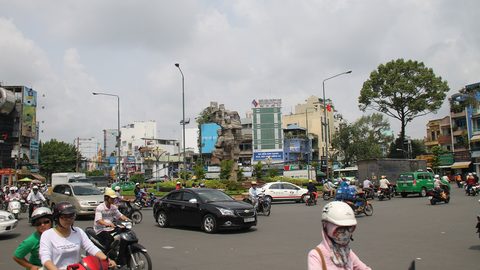
The Hanoi comparison is the single most useful tool for understanding Saigon, because the two cities are opposites in almost every aspect that matters to a visitor. Hanoi sits on lakes, with a compact Old Quarter where streets are narrow, walkable, and named after the guilds that once occupied them. The air is cooler from October through March. The colonial architecture clusters around Hoan Kiem Lake in a way that produces genuine postcard moments. Ho Chi Minh City has none of that. Its French colonial bones, roughly 15 to 20 buildings of note, are scattered among skyscrapers and 1980s apartment blocks. Its historic core is District 1, which is not an old quarter in any European or Vietnamese sense: it is a grid of wide boulevards built by the French and now crammed with motorbike traffic. There are no lakes. There is almost no quiet green space. The heat and humidity sit at 75 to 80 percent year-round, and the sensory overload of eight and a half million motorbikes is constant.
What Saigon Counters With
What Saigon has instead is a density of street food that Hanoi cannot match, a war-history museum that draws roughly a million visitors annually, and a commercial energy that makes every street feel like a market. Hanoi has more visible history and a slower rhythm. Saigon has better cơm tấm and a relentless, electrifying chaos. The traveller who prefers Hanoi is making a rational choice for walkability, atmosphere, and a cooler climate. The traveller who prefers Saigon is making an equally rational choice for food and intensity. Neither is wrong. Knowing which one you are is the whole point of reading a comparison page.
Saigon Honest Review: What Works and What Wears You Down
The Street Crossing Problem
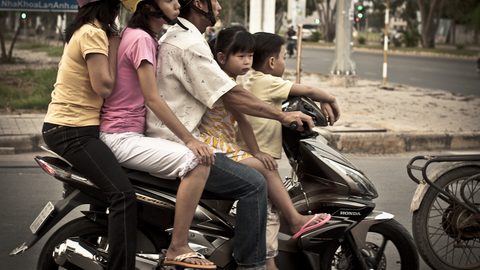
A Saigon honest review has to start with the street crossing problem. Crossing a road in District 1 requires you to step off the kerb into moving traffic and walk at a slow, predictable pace while the motorbikes flow around you. Stopping or running is dangerous. This does not feel natural on day one. It does not feel natural on day three. Locals navigate it without looking; visitors find it harder than they expected. The pavement situation makes walking exhausting: motorbike parking on the pavement forces pedestrians onto the road, and the broken surfaces turn a five-minute walk into an obstacle course.
The Food: Worth the Trip
The street food is the strongest reason to come. The city's benchmark bánh xèo at 46A is served in a chaotic alley off a main road. The consensus best bánh mì, Bánh Mì Huỳnh Hoa at 26 Lê Thị Riêng, only opens at 2:30pm and sells out within hours. The cơm tấm standard is Cơm Tấm Mộc at 85 Lý Tự Trọng, where charcoal-grilled pork chop sits over fractured rice grains. You eat most of this on tiny plastic stools by the side of the road, inhaling exhaust fumes. That is the bargain: exceptional food eaten in conditions that would not pass a health inspection in your home country.
The War History
The War Remnants Museum, entry fee 40,000 VND at the museum ticket office, is the most impactful war museum in Southeast Asia. The Cu Chi Tunnels, entry fee 110,000 VND for the Bến Đình site or 90,000 VND for the Bến Dược site, draw about 1.5 million visitors annually. Both are essential for anyone with an interest in 20th-century conflict. Neither is an easy day. The tunnels are claustrophobic, hot, and require a half-day tour from District 1. The museum is harrowing and takes at least two hours.
Is Saigon Safe for Tourists? the Real Risks and How to Manage Them
Crime and Traffic
The question of whether Saigon is safe for tourists is answered best by looking at the specific risks rather than a general verdict. Bag and phone snatching by motorbike riders is a real risk. Hold your phone loosely at your peril, a death grip invites a snatch, but a dangling phone in an outer pocket is at even higher risk. The traffic fatality rate per 100,000 in Vietnam was 19.5 in the 2023 WHO estimate, and Ho Chi Minh City has the highest traffic density in the country with roughly 8.5 million registered motorcycles. That does not mean you will be in a crash. It means you need to treat every road crossing as a deliberate act.
Getting Around Safely
Grab drivers frequently cancel rides during rush hour, 7:30 to 9:00 AM and 4:30 to 6:30 PM, or in heavy rain, leaving you stranded. Order a car earlier than you think you need it, or walk to a less congested street before summoning a ride. The city's 4G coverage is excellent, but you must buy a Viettel or Mobifone SIM at an official airport counter immediately after baggage claim, around 200,000 VND for a month of data. Avoid street resellers. The Grab super-app is non-negotiable for transport. Download and attempt verification before departure because airport Wi-Fi is unreliable and SMS verification can fail on foreign numbers.
Ho Chi Minh City First Impression: What Hits You First
Leaving the Airport
Your Ho Chi Minh City first impression comes before you leave the airport. Tan Son Nhat International Airport sits just 7 km from District 1, and the taxi ride through the city's arteries is a lesson in Vietnamese traffic logic. Use only Vinasun or Mai Linh taxis; the cost runs 100,000 to 150,000 VND and takes 20 to 40 minutes. Ride-hailing via the Grab app is slightly cheaper, with pick-up at designated columns outside the terminal. The public bus 109 goes to the Ben Thanh area for 20,000 VND and takes 30 to 45 minutes.
The View from the Window
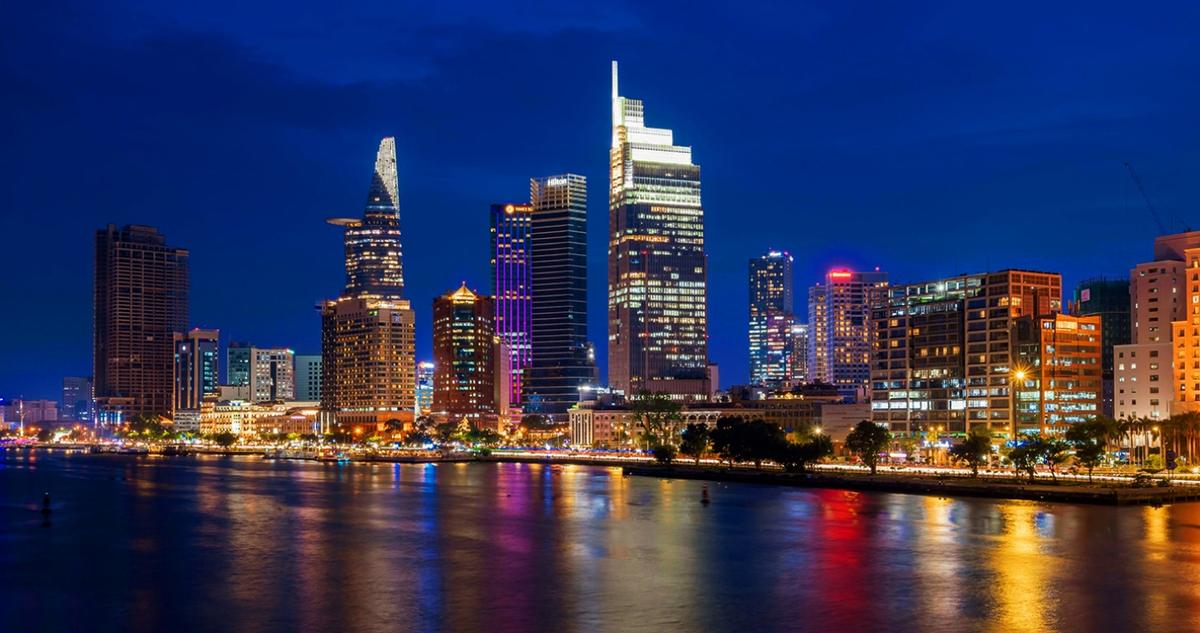
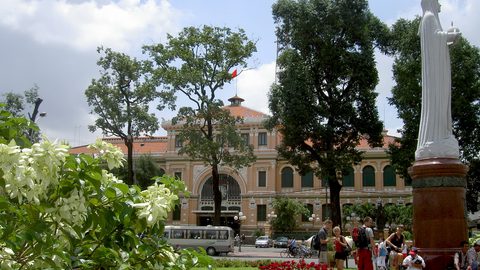
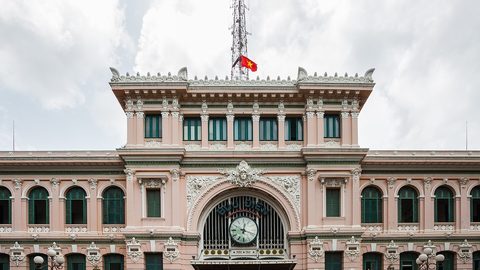
The first impression from the taxi window is one of scale. Ho Chi Minh City covers 2,095 km² and holds roughly 9.3 million people, making it larger in population than Hanoi's 8.5 million but smaller in area, Hanoi covers 3,359 km². The density is what hits you: high-rises next to single-storey tube houses, a luxury tower reflecting onto a row of street-food stalls on broken pavements, and motorbikes in every lane and on every pavement. The sensory overload is immediate and does not let up. The lack of quiet green space is noticeable within an hour. Arriving from a quieter city, plan a low-key first afternoon. Stay in District 1, walk the block around the Central Post Office and Notre-Dame Cathedral Basilica (exterior viewing only, under long-term renovation), and get a coffee at a sidewalk cart. The city rewards acclimatisation, not a full schedule on day one.
Who Should Visit and Who Should Skip
The Right Visitor for Saigon
The city is best for a specific profile: urban adrenaline junkies who thrive on sensory overload, street-food obsessives willing to perch on tiny plastic stools, history buffs focused on 20th-century conflict, digital nomads seeking a low-cost high-energy base, and second-time Southeast Asia travellers ready for grit over temples. If that describes you, three full days is the minimum recommended stay: one for District 1 landmarks and war history, one for Cholon's markets and temples, one for food culture and a night out. The maximum justified stay for a typical first-time visitor is also three days. Beyond that, you will either love it enough to extend or be ready to leave.
Who Should Stay Away
The city is not for first-time travellers seeking a gentle, clean, or relaxing Asian introduction. It is not for anyone with serious mobility issues. Pavements are an obstacle course, and few buildings have ramps. It is not for anyone who hates noise, humidity, or constant haggling. Beach lovers should note that there is no beach in the city; the nearest coastal escape is Vung Tau, two hours away by fast hydrofoil. The traveller who wants postcard beauty and walkable heritage is better served by Hoi An, a UNESCO World Heritage Site since 1999 with a 0.3 km² pedestrianized Old Town. The traveller who wants slow river life should budget two nights for the Mekong Delta as a standalone destination, not a day trip.
The Backpacker Trap
The common mistake visitors make is staying exclusively in the backpacker enclave of Pham Ngu Lao and Bui Vien Street and concluding the city has no charm. That area is a loud, drunken anomaly, not representative of the city's deeper culinary and cultural neighbourhoods. The areas that reward exploration are District 3 with its leafy villas and hidden cafes, District 4 with its gritty island food scene, and District 5 where Cholon's wholesale chaos and medicinal herb streets demand a full morning.

When to Go and When to Stay Home
The Dry Window
The peak season runs December to March. This is the dry season with lower humidity, average temperatures around 27°C, and minimal rain, making walking bearable. Bookings spike around Christmas, New Year, and Tet, the Vietnamese Lunar New Year that falls in late January or February each year. The Tet closure is the single biggest calendar trap for visitors: the city empties out as millions return to hometowns, and many restaurants, markets, and shops close for up to a week. Transport is overbooked. Arrive during Tet without a local contact, and you will struggle to find a meal or a ride.
The Wet Months
The window to avoid is late September through October, the peak of the monsoon season with heavy daily downpours and localised street flooding. The months with highest rainfall run May through November, while December through April have the lowest rainfall. The average annual temperature is 28°C, and the average annual humidity sits at 75 to 80 percent. There is no cool season that makes outdoor exploration comfortable for long stretches. Plan your day around the morning hours, dawn to 10:30 AM. Accept that the afternoon will be for coffee shops, air-conditioned museums, or a nap.
Day Trips Worth Your Time
The Big Two
The Cu Chi Tunnels, 40 to 70 km from District 1 depending on which site you visit, are the most popular day trip. Book a half-day tour through a reputable operator; you will spend 1.5 hours in a private car or bus each way. The Mekong Delta is accessible as a day trip to the provinces of Tiền Giang, Bến Tre, or Vĩnh Long, about 70 to 100 km from Ho Chi Minh City depending on your embarkation point. The standard day trip is a tourist-trap boat circuit with coconut candy workshops and honey tea, but it does give you a glimpse of river life. If you want anything deeper, budget two nights as a standalone destination.
Quieter Alternatives
The less crowded alternatives are Can Gio Mangrove Forest, two hours by speedboat or car, where you can see monkeys, crocodiles, and a quiet beach, and Dong Nai's Buu Long Park, one hour by car, which is a serene lake and pagoda nicknamed mini Ha Long. Vung Tau is a local beach escape two hours away by fast hydrofoil or car. It is crowded on weekends and the water is not the turquoise you might be hoping for.
Read next
-

 Ho Chi Minh City Hotels From Converted Villas to Skydeck Towers by Price Band
Ho Chi Minh City hotels sorted by property type and price band, from converted District 3 villas to skydeck towers near the Saigon River.
Ho Chi Minh City Hotels From Converted Villas to Skydeck Towers by Price Band
Ho Chi Minh City hotels sorted by property type and price band, from converted District 3 villas to skydeck towers near the Saigon River.
-
 Ho Chi Minh City Where to Stay District by District for Every Travel Style
Where to stay in Ho Chi Minh City: a district-by-district breakdown of Saigon neighbourhoods from chaotic District 1 to the expat calm of Thao Dien.
Ho Chi Minh City Where to Stay District by District for Every Travel Style
Where to stay in Ho Chi Minh City: a district-by-district breakdown of Saigon neighbourhoods from chaotic District 1 to the expat calm of Thao Dien.
-
 Flying to Ho Chi Minh City Airport Guide and the Airlines That Serve SGN
Airlines flying into Tan Son Nhat Airport (SGN), terminal details, and a step-by-step arrival guide for getting from the plane into Ho Chi Minh City.
Flying to Ho Chi Minh City Airport Guide and the Airlines That Serve SGN
Airlines flying into Tan Son Nhat Airport (SGN), terminal details, and a step-by-step arrival guide for getting from the plane into Ho Chi Minh City.
-
 Ho Chi Minh City Things to Do Ranked From War History to Wholesale Flower Markets
Ho Chi Minh City things to do ranked with honest verdicts: which Saigon war-history sights, markets, and temples earn your three days and which to skip.
Ho Chi Minh City Things to Do Ranked From War History to Wholesale Flower Markets
Ho Chi Minh City things to do ranked with honest verdicts: which Saigon war-history sights, markets, and temples earn your three days and which to skip.
-
 Ho Chi Minh City Best Time to Visit Month by Month Avoiding Tet Closures and Monsoon Flooding
Ho Chi Minh City best time to visit month by month: dry season windows, Tet holiday closures that empty the city, and the monsoon flooding to avoid.
Ho Chi Minh City Best Time to Visit Month by Month Avoiding Tet Closures and Monsoon Flooding
Ho Chi Minh City best time to visit month by month: dry season windows, Tet holiday closures that empty the city, and the monsoon flooding to avoid.
-
 Ho Chi Minh City Getting Around Without Losing Your Phone or Your Nerve
Getting around Ho Chi Minh City: Grab app tactics, airport transfers from Tan Son Nhat, and how to cross a Saigon street without stopping or running.
Ho Chi Minh City Getting Around Without Losing Your Phone or Your Nerve
Getting around Ho Chi Minh City: Grab app tactics, airport transfers from Tan Son Nhat, and how to cross a Saigon street without stopping or running.
-
 War Remnants Museum
The War Remnants Museum in Ho Chi Minh City is the most emotionally affecting stop in the city. Here is what to expect and how to prepare.
War Remnants Museum
The War Remnants Museum in Ho Chi Minh City is the most emotionally affecting stop in the city. Here is what to expect and how to prepare.
-
 Reunification Palace
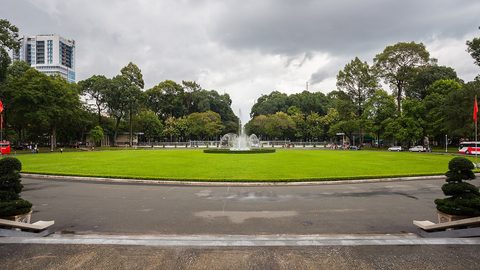
The Reunification Palace in Ho Chi Minh City is famous for its tank gate, but the basement war command bunker is the part that explains the building.
Reunification Palace
The Reunification Palace in Ho Chi Minh City is famous for its tank gate, but the basement war command bunker is the part that explains the building.
-
 Ben Thanh Market
 in Ho Chi Minh City is a tourist trap for souvenirs but genuinely good for lunch. Here is what to eat and what to skip.
Ben Thanh Market
Ben Thanh Market in Ho Chi Minh City is a tourist trap for souvenirs but genuinely good for lunch. Here is what to eat and what to skip.